Rice Noodles, Explained — Every Shape, Cuisine, and Use Case
Rice noodles explained from origin to plate — every shape (bánh phở, sen lek, sen yai, vermicelli), every cuisine, gluten-free status, calories, and use cases.

Rice noodles are noodles made from rice flour and water, sometimes with a small amount of tapioca starch added for elasticity. They originated in southern China around 200 BCE and spread south through Vietnam, Thailand, the Philippines, and Burma. Today they anchor most of Southeast Asian noodle cuisine — pho, pad thai, chow fun, pancit, mohinga — and they're naturally gluten-free. The shape determines the dish.
What rice noodles actually are
The base recipe is two ingredients: rice flour and water. Mid-grain or long-grain rice is milled to flour, mixed with water into a slurry, and either steamed into sheets or extruded through dies. Some brands add 5-15% tapioca starch to improve elasticity and reduce breakage — Three Ladies and most US-distributed Thai brands include it; some artisan Vietnamese producers do not.
Two production methods cover nearly everything on the shelf:
- Sheet method — used for flat shapes (bánh phở, sen lek, sen yai, he fen). The rice slurry is poured onto a flat steaming surface, cooked into a thin pliable sheet, then cut into strands of the target width. Fresh he fen is sold as the uncut sheet for the cook to slice at home.
- Extrusion method — used for round shapes (rice vermicelli, bún, mai fun). The dough is forced through small holes in a metal die under pressure, then steamed and either dried or sold fresh.
Texture-wise, rice noodles cook to a slippery, tender chew. They have no gluten, so they never develop the bouncy springiness of wheat noodles. Overcooked rice noodles go from tender to mushy with no in-between — the cooking window is narrow, which is the single most common mistake home cooks make.
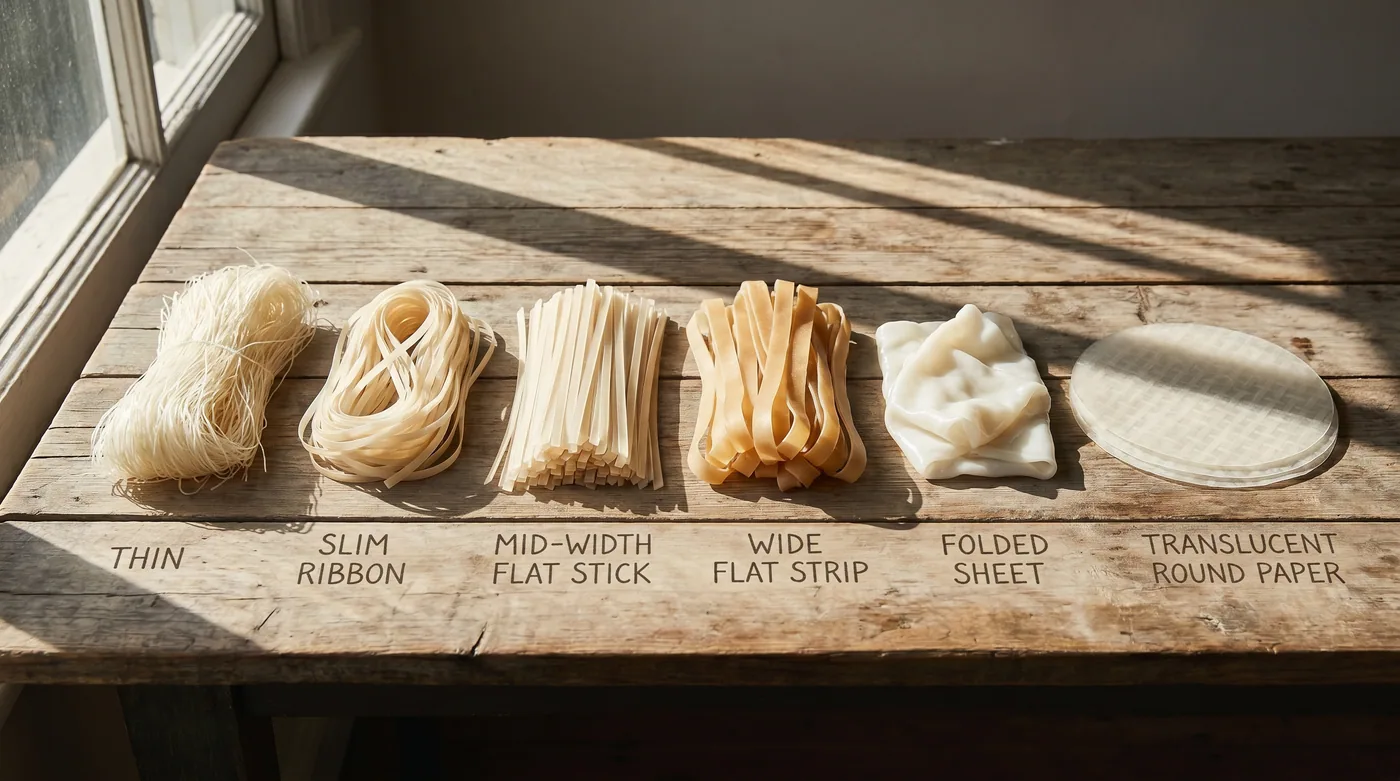
The six rice noodle shapes you need to know
Width is the most useful organizing principle. Country of origin matters less than people assume — a Thai sen lek and a Vietnamese hủ tiếu mềm sit at nearly the same width and work in similar dishes. Pick the width first.
| Shape | Diameter | Origin | Cuisine context | Typical dish |
|---|---|---|---|---|
| Rice vermicelli (bún / mai fun) | ~1mm | Southern China, Vietnam | Vietnamese, Chinese, Filipino | Vietnamese bún bowls, Singapore noodles, pancit bihon |
| Bánh phở (banh fuh) | ~3mm flat | Vietnam | Vietnamese | Pho |
| Sen lek (sen lek) | ~5mm flat | Thailand | Thai | Pad thai, boat noodle soup |
| Sen yai (sen yai) | ~10mm flat | Thailand | Thai | Pad see ew, drunken noodles |
| Chinese flat rice noodle (he fen / chow fun) | ~10-15mm flat | Guangdong, China | Cantonese, Hakka | Beef chow fun, he fen stir-fries |
| Rice paper (bánh tráng) | Round sheets, paper-thin | Vietnam | Vietnamese | Fresh spring rolls (not strictly a noodle) |
A few notes on the table:
Rice vermicelli is the catch-all for any threadlike rice noodle. Vietnamese call it bún (boon); Cantonese-speakers call it mai fun (my fun); Filipinos call it bihon. Same product, different language. Almost always sold dry in nests or bundled sticks.
Bánh phở is the Vietnamese pho noodle — flat, 3mm wide, made from rice flour and water with no other major additions. The Brooklyn-based Three Ladies brand is the US restaurant standard.
Sen lek is the Thai pad thai noodle. Real pad thai uses sen lek, the 5mm flat sen lek rice stick. Cheaper restaurants substitute 1mm vermicelli — wrong shape, wrong texture, wrong dish.
Sen yai is the wider Thai cousin, and the noodle pad see ew (literally "stir-fried with dark soy") is built around. Sen yai also defines drunken noodles (pad kee mao).
He fen (also spelled ho fun, written 河粉) is the Cantonese flat rice noodle, sold fresh as folded sheets and dried as wide strands. Beef chow fun is the canonical dish.
Rice paper isn't strictly a noodle — it's the dried round sheet for Vietnamese fresh spring rolls (gỏi cuốn). It shares the aisle, so it earns the mention.
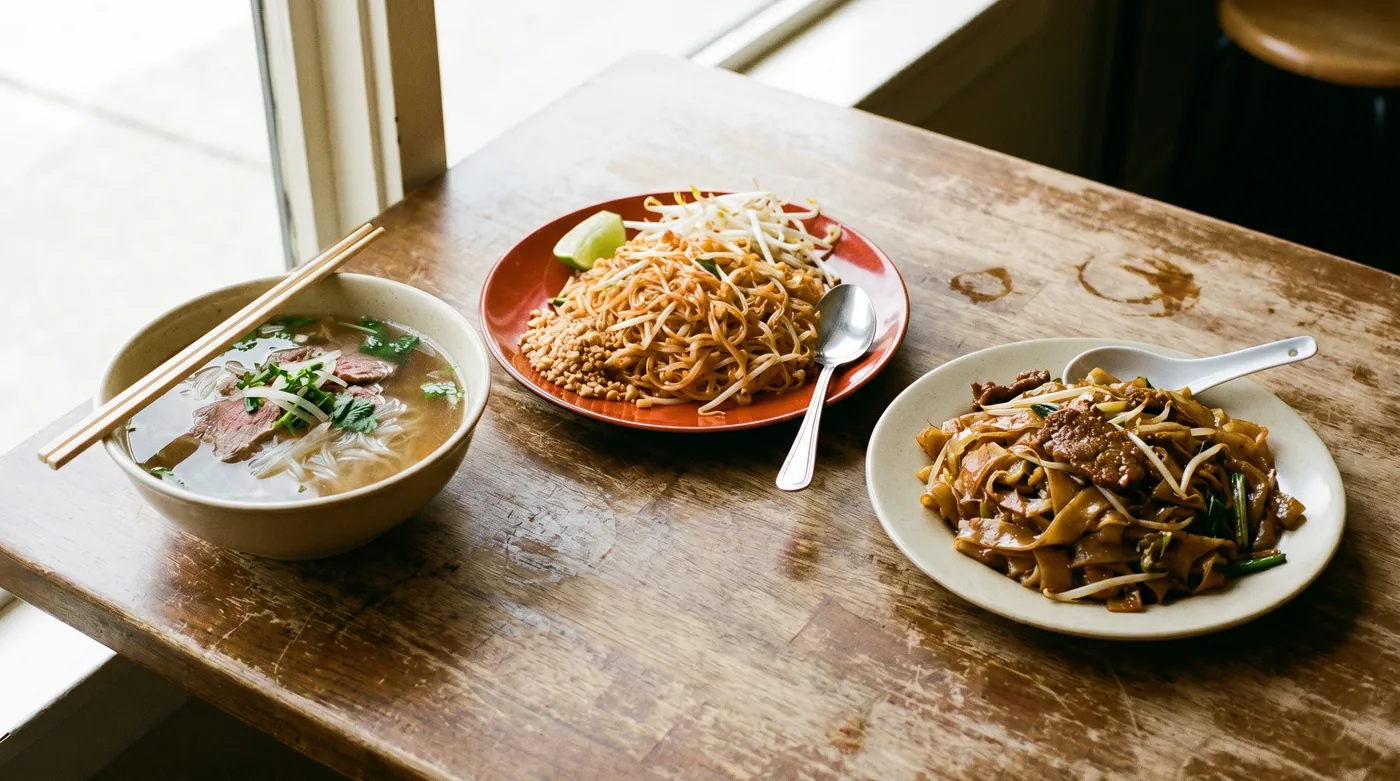
Cuisine-by-cuisine: where rice noodles appear
Rice noodles spread across South and Southeast Asia in parallel, and each cuisine built its own catalog of named dishes around them. Here's the regional breakdown.
Vietnamese
Vietnam has the deepest rice noodle catalog in the world. Phở (fuh) uses 3mm flat bánh phở in a long-simmered beef or chicken broth — the country's primary culinary export to the US. Bún (boon) refers both to thin rice vermicelli and to the family of dishes built around it: bún chả (grilled pork over vermicelli), bún bò Huế (spicy Huế-style beef soup), bún riêu (crab and tomato soup). Banh canh (banh ganh) is a thicker round tapioca-and-rice noodle for southern Vietnamese soups.
Thai
Thailand organizes rice noodles by width with explicit names. Sen mee is the 1mm vermicelli. Sen lek is the 5mm flat for pad thai and boat noodle soup. Sen yai is the 10mm wide flat for pad see ew (pad see ew) and drunken noodles (pad kee mao). Northern Thai khao soi (cow soy) uses a flat egg-and-wheat noodle instead — the regional exception.
Chinese
Rice noodles concentrate in southern China — Guangdong, Fujian, Yunnan. He fen (Cantonese: ho fun) is the wide flat for beef chow fun and other Cantonese stir-fries. Mai fun (my fun) is the vermicelli used in Singapore noodles (a Hong Kong dish, despite the name). Guilin mifen and Yunnan crossing-the-bridge noodles are two regional rice noodle traditions worth knowing.
Filipino
The Philippines built the pancit category around rice and wheat noodles imported from Chinese traders. Pancit bihon uses rice vermicelli (bihon) with soy sauce, vegetables, and shredded chicken or pork. Pancit shows up at every Filipino birthday — long noodles symbolize long life.
Burmese
Mohinga (moh-hin-ga) is the Burmese national breakfast — rice vermicelli in a catfish-and-banana-stem broth thickened with chickpea flour and roasted rice powder.
Are rice noodles gluten-free?
Yes, by default. Pure rice noodles contain only rice flour and water, sometimes with tapioca starch — none of those ingredients contain gluten. That makes rice noodles one of the most reliable starch swaps for people with celiac disease or non-celiac gluten sensitivity.
Two caveats matter.
First, the label still needs a check. A small number of budget brands blend rice flour with wheat starch to cut cost. The result is a noodle that looks identical to a pure rice product but contains gluten. Any brand that includes "wheat" or "wheat starch" in the ingredient list is not gluten-free. Mainstream US brands that are reliably pure rice — Three Ladies, A Taste of Thai, Annie Chun's, Lotus Foods, Erawan — list rice flour (and sometimes tapioca starch) only.
Second, cross-contamination is a real risk in shared facilities. Rice noodles made on equipment that also processes wheat noodles can pick up trace gluten — not enough to bother most people, but enough to react in celiac patients. For certified safety, look for a third-party gluten-free certification mark (GFCO, Coeliac UK) on the packaging. Lotus Foods, King Soba, and Annie Chun's carry the certification on most of their lines.
Calories and nutrition
Per 100g cooked, plain rice noodles run 109 calories, with the following macros per USDA FoodData Central:
| Nutrient | Per 100g cooked rice noodles | Per 100g cooked wheat pasta | Per 100g cooked instant ramen |
|---|---|---|---|
| Calories | 109 kcal | 158 kcal | 174 kcal |
| Carbs | 25g | 31g | 26g |
| Protein | 0.9g | 5.8g | 4g |
| Fat | 0.2g | 0.9g | 7.3g |
| Sodium | under 5mg | 1mg | 700-1,200mg |
Rice noodles run lower-calorie than wheat pasta and significantly lower-calorie than instant ramen (the fat content in instant ramen comes from the pre-frying step). Sodium on plain rice noodles is effectively zero — that changes once the dish gets built. A bowl of pho with broth and meat runs 350-500 calories total; pad thai runs 400-700 depending on the restaurant.
The macro trade-off is protein: rice noodles deliver under 1g per 100g serving, compared to nearly 6g in wheat pasta. For a rice-noodle-based meal to hit reasonable protein targets, the dish needs meat, tofu, eggs, or shrimp doing most of the work.
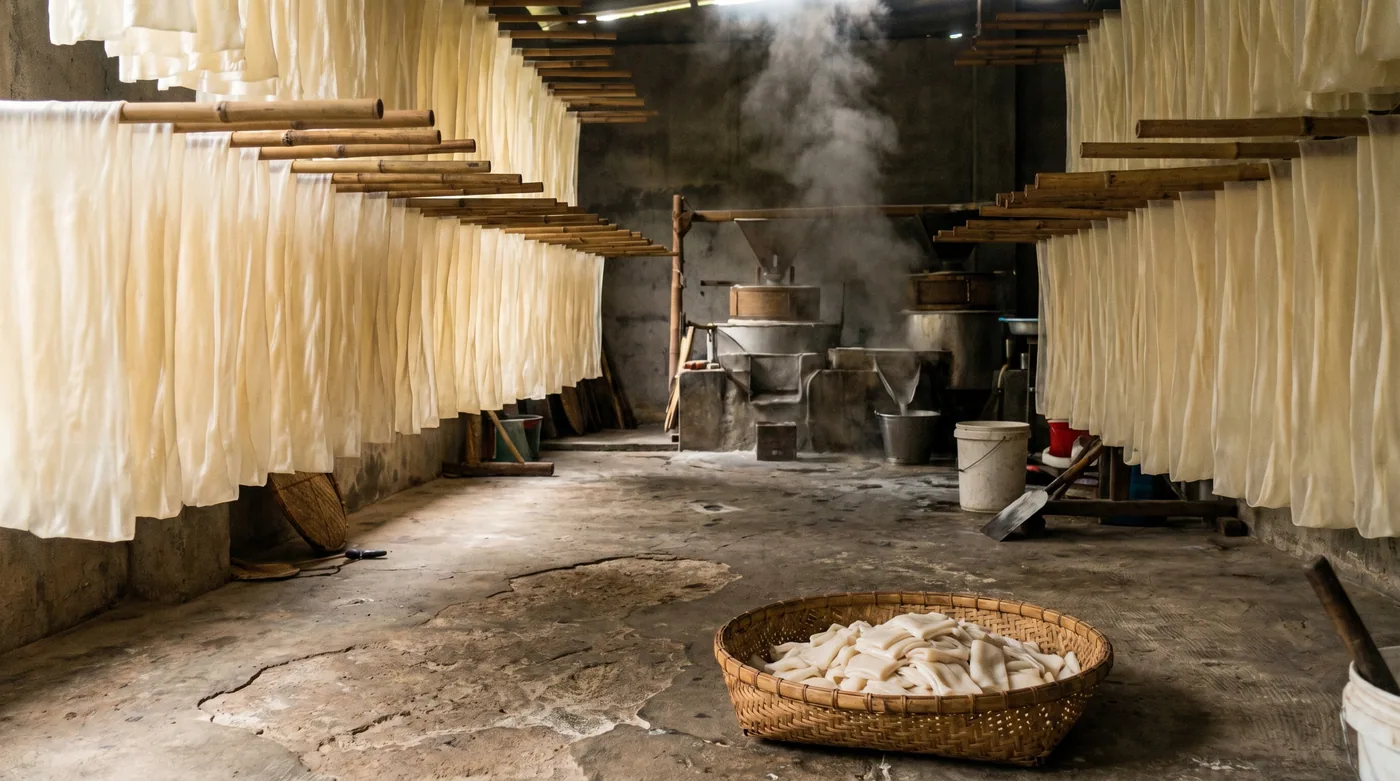
Fresh vs dry rice noodles
Rice noodles come in two formats in the US, and the choice changes both texture and shopping strategy.
Fresh rice noodles are sold refrigerated in the produce or chilled section of Asian groceries. They look like translucent white sheets or thick coils, often packaged in vacuum-sealed plastic. The texture is silkier and the cook time is shorter — fresh he fen needs 30-60 seconds in a wok, while fresh bánh phở needs a brief 15-30 second rinse in hot broth. Shelf life is short (5-7 days refrigerated) and they harden after 2 days, so the timing window is tight. Available at H Mart, 99 Ranch, and most regional Asian groceries; rare in mainstream US chains.
Dry rice noodles are the cellophane-bagged sticks that dominate the rice noodle aisle. Shelf life is 1-2 years. Preparation requires a cold or warm soak (5-15 minutes depending on width) followed by a brief blanch in boiling water. Available everywhere — H Mart, 99 Ranch, Whole Foods, Walmart, Amazon. The dry format is what 95% of US home cooks use, and it produces an excellent result if the soaking step is handled correctly.
For pad thai and pad see ew, dry is the universal standard — even high-end Bangkok restaurants use dry sen lek. For pho, fresh is preferable when available, but dry bánh phở (rinsed briefly in hot broth, not boiled) holds up well.
Where to buy rice noodles in the US
The shopping hierarchy:
Asian grocery chains (H Mart, 99 Ranch). Full rice noodle aisle — every shape, fresh and dry, both Vietnamese and Thai sourcing. Three Ladies (the Brooklyn-distributed Vietnamese brand) is reliably stocked; Erawan and Pantai dominate the Thai side. Best selection, lowest per-unit pricing.
Mainstream US grocery (Whole Foods, Walmart, Kroger). Stocks dry rice noodles only — typically A Taste of Thai, Annie Chun's, and sometimes Lotus Foods. Limited shape selection — usually pad thai sticks (sen lek) and rice vermicelli, occasionally bánh phở. Convenient if you're not near an Asian grocery; not the place to find sen yai or he fen.
Amazon. Stocks Three Ladies, A Taste of Thai, Annie Chun's, Lotus Foods, and Erawan with multi-pack pricing. Useful for shapes — bánh phở, sen yai, mai fun — that mainstream chains skip.
Brand callouts: Three Ladies (US restaurant standard for bánh phở), A Taste of Thai (mainstream pad thai stick), Annie Chun's (mass-market gluten-free certified), Lotus Foods (organic, certified gluten-free), Erawan (Asian-grocery standard for Thai shapes).
For the full breakdown of which brand to buy for which dish, see Best Pho Noodles & Kits and Best Pad Thai Noodles & Sauces.
Common mistakes when cooking rice noodles
Four mistakes account for most failed home-cooked rice noodle dishes.
Over-soaking dry noodles. The most common error. Dry rice noodles need a cold or warm-water soak — 5 minutes for vermicelli, 10-12 minutes for bánh phở, 15 minutes for sen lek. Soaking past those windows produces noodles that fall apart in the wok. Soak until the noodle bends without snapping; that's done.
Boiling instead of soaking. Many recipes call for boiling dry rice noodles like wheat pasta. That's wrong for stir-fries. Boiling cooks the noodle fully before it hits the wok, and the additional pan time turns it to mush. Correct sequence: cold-soak until pliable, then stir-fry — the noodles finish cooking in the sauce.
Not rinsing after cooking. Cooked rice noodles release starch that makes them clump. For cold preparations (Vietnamese vermicelli salads, summer rolls), rinse under cold water until the water runs clear, then drain.
Using the wrong width for the dish. Pad thai needs 5mm sen lek; substituting 1mm vermicelli produces a tangle, not pad thai. Pho needs 3mm bánh phở; using sen yai produces a bowl that's structurally wrong. Read the dish, then buy the width.
Related reading
- Pho (Vietnamese rice noodle soup) — the deepest dive on the canonical bánh phở dish
- Pad Thai (Thai stir-fried rice noodles) — sen lek's defining preparation
- Best Pho Noodles & Kits — brand-by-brand bánh phở buying guide
- Best Pad Thai Noodles & Sauces — sen lek and tamarind sauce picks
- Korean Ramyeon vs Japanese Ramen — adjacent noodle tradition — for the wheat-noodle side of East Asian cuisine
FAQ
Are rice noodles gluten-free? Yes by default — pure rice noodles contain only rice flour, water, and sometimes tapioca starch. Check labels for budget wheat-starch blends; look for third-party certification if cross-contamination matters.
Rice noodles vs wheat noodles? Rice noodles are rice flour and water (gluten-free, slippery tender chew, Southeast Asian cuisine). Wheat noodles develop gluten and bounce (northern Chinese, Japanese, Korean).
What are the different types of rice noodles? Six: vermicelli (1mm), bánh phở (3mm flat), sen lek (5mm flat), sen yai (10mm flat), he fen / chow fun (10-15mm wide), and rice paper. Width drives dish choice.
How are rice noodles made? Flat shapes steam a rice-flour batter into sheets, then cut to width. Round shapes extrude through dies under pressure. Tapioca starch is sometimes added (5-15%) for elasticity.
How many calories are in rice noodles? Around 109 calories per 100g cooked — 25g carbs, 0.9g protein, 0.2g fat, near-zero sodium. Lower than wheat pasta (158) and instant ramen (174).
Which rice noodle for pho vs pad thai? Pho uses bánh phở (3mm flat) — Three Ladies is the US standard. Pad thai uses sen lek (5mm flat) — A Taste of Thai and Erawan are common. Not interchangeable.