
Samyang Foods is the South Korean company that invented Korean instant ramen, almost destroyed itself with a 1989 industrial-tallow scandal, and rebuilt the brand globally three decades later through a viral spicy noodle. The story is a clean arc: 1961 founding, 1963 first product, 27 years of dominance, one televised allegation in 1989 that crashed the company's market share, decades of rebuilding behind a younger rival's dominance, then a single product launch in 2012 — Buldak — that turned Samyang into the world's most-exported Korean instant noodle brand. Here's the full picture.
What is Samyang?
Samyang Foods Co., Ltd. (삼양식품, sahm-yahng) is the Korean instant-noodle manufacturer founded in 1961 by Jeon Joong-yoon. The company is publicly traded on the KOSPI (ticker 003230), headquartered in Wonju in Gangwon Province, and produces around 1.2 billion packets of instant noodles per year. It is not the same company as Samyang Group (삼양그룹) — a separate chemicals-and-optics conglomerate founded in 1924 — even though they share the romanized name. If you've heard of Samyang lenses on a camera, that's Samyang Group; the ramen company has no relationship to it.
Samyang's product line has two anchor points: the original Samyang Ramen (1963, the chicken-broth flagship still in production) and the Buldak product family (2012+, the viral fire-chicken stir-fry covered separately on the Buldak page). Beyond those two anchors, the company ships a wider catalog — Naengmyeon cold noodles, Bulgogi Ramen, Curry Ramen, the Sutgarak home-style line — most of which never reached mainstream US distribution.
The 1961 founding — and Korea's first instant ramen, 1963
Jeon Joong-yoon was a sugar trader in Seoul in the late 1950s when he started looking for a cheaper way to feed Korea's post-war urban population. The wage economy was reviving, but rice supplies were thin, and bread hadn't yet caught on as a staple. On a 1962 trip to Japan, he visited Nissin Foods — the company Momofuku Ando had founded four years earlier with the first commercial instant ramen — and watched the production process. He came back with a manufacturing license, a flavor formula, and the conviction that the same product could work in Korea.
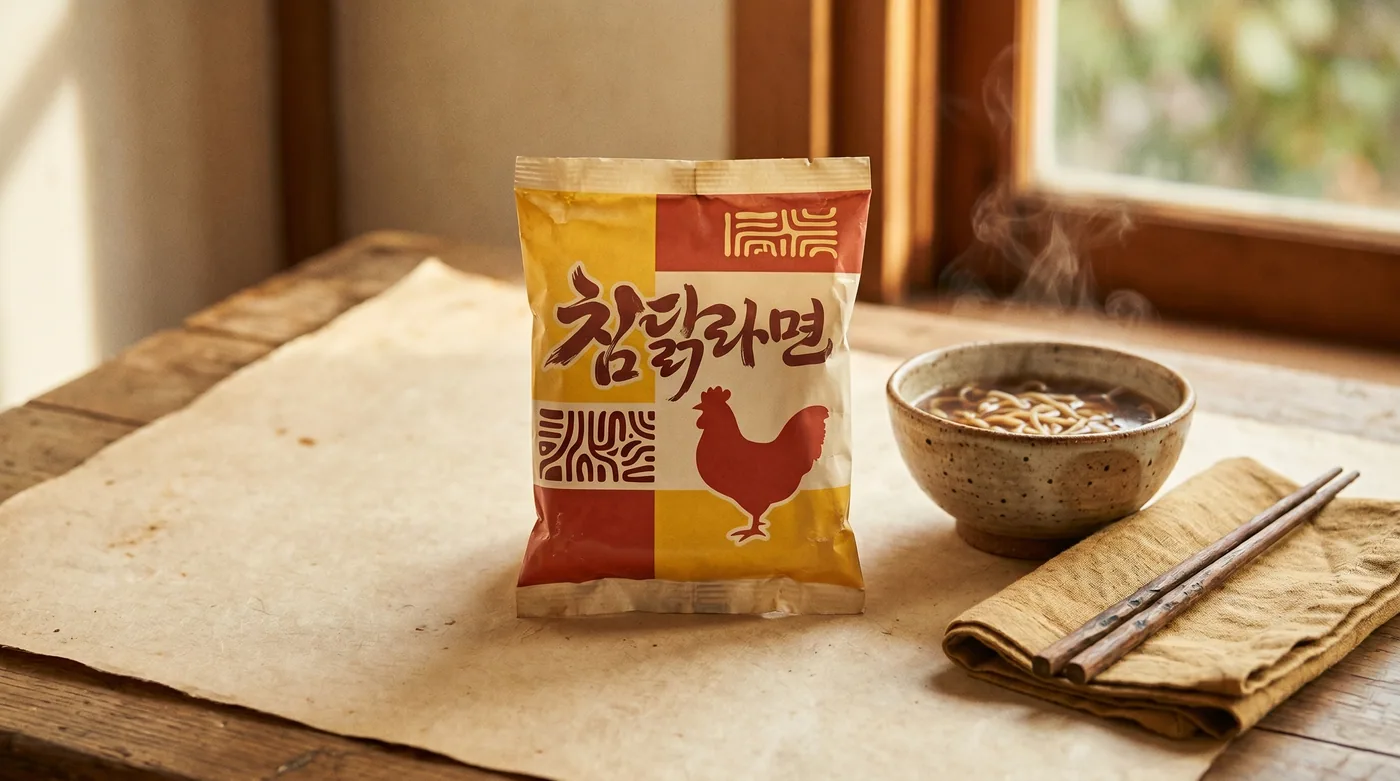
Samyang Ramen launched on September 15, 1963 at a retail price of 10 won per packet — less than a US cent at the time. The packet was yellow and red with a chicken silhouette on the front, the broth was a mild chicken-and-red-pepper profile, and the noodles were fried in beef tallow before drying. Sales were slow for two years (Koreans hadn't yet adopted noodle-soup as a meal format), but by 1966 the product had become Korea's first nationally-distributed convenience food. Through the 1970s, Samyang Ramen was the Korean instant noodle — the category was effectively a monopoly.
By the late 1980s, Samyang had ~60% market share and was the country's largest food brand outside Lotte's confectionery line. Nongshim, founded by Shin Choon-ho in 1965, was a distant second.
1989 — the scandal that nearly killed Samyang
On November 3, 1989, Korean prosecutors held a televised press conference accusing Samyang of using industrial-grade beef tallow — they called it "wax oil" (sa-yong-yu), implying it was the kind of fat used in candle-making — in its noodle frying process. The Seoul District Prosecutor's Office charged seven Samyang executives with food-safety violations.
The reaction was instant and brutal. Korean grocery shelves were stripped of Samyang products within 48 hours. Mothers' associations organized boycotts. Within three months, Samyang's sales had dropped 75 percent. The company laid off approximately 1,000 employees and came within months of insolvency.
Six years later, the Supreme Court of Korea reversed the verdict in 1995, finding that the beef tallow Samyang used was, in fact, edible-grade Australian beef fat properly inspected and FDA-equivalent compliant. The court ruled that the prosecutors had relied on an incorrect industrial classification when filing the original charges. Samyang was vindicated. But by then, Korean consumers had spent six years in the absence of Samyang on their shelves — and Nongshim's Shin Ramyun (launched 1986) had taken over the position Samyang Ramen had held since 1963.
The scandal is the single most consequential event in Korean instant-ramen history. Generations of Koreans now in their 40s and 50s still carry the association. Samyang's market-share position in Korea has never returned to pre-1989 levels.
The slow recovery and the Buldak comeback
Through the 1990s and 2000s, Samyang held a steady but distant #2 position in Korean instant noodles. Loyal older customers stayed with Samyang Ramen Original, but the younger generation grew up associating ramyeon with Shin Ramyun. The company experimented with reformulated lines (Samyang Bulgogi Ramen, Samyang Curry Ramen, the Sutgarak premium line) but none broke through.
The pivot came from inside the family. Kim Jung-soo, daughter of the founder and an executive who'd been with the company since the early 1990s, became CEO in 2010. She'd been tracking a particular consumer pattern: Korean diners were increasingly seeking out extra-spicy food as a stress-coping behavior, and a small Seoul restaurant in Myeongdong had been generating lines around the block for a fire-chicken (buldak) dish that was almost punishingly hot. Kim sent Samyang's R&D team to study the dish, and on April 16, 2012, the company launched Buldak-bokkeum-myeon — fire-chicken stir-fried noodle.
By 2014, the Fire Noodle Challenge video format had spread the product globally. By 2018, Samyang's overseas revenue had multiplied 25x. By 2024, the company's market capitalization had grown approximately tenfold from pre-Buldak levels, and Buldak accounted for roughly 70% of total revenue. For the full Buldak story — origin, flavor lineup, viral history, Scoville facts — see the dedicated Buldak brand page.
The brand inversion is the headline: in Korea, Nongshim still outsells Samyang roughly 2:1. Globally, Samyang outsells Nongshim 3:1 — driven almost entirely by Buldak.
The Samyang product family today
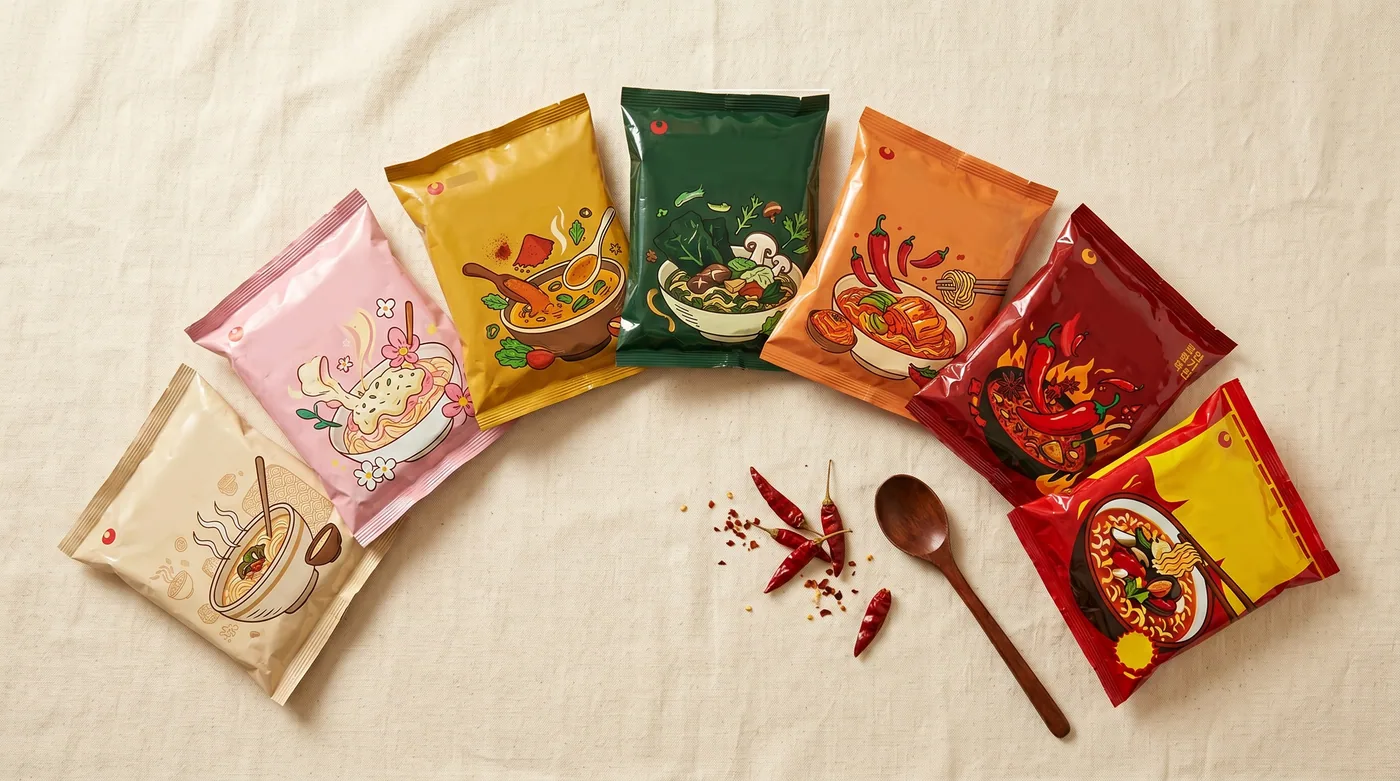
Beyond Buldak, the active Samyang lineup includes:
- Samyang Ramen Original (1963) — the flagship, still in production with the original chicken-and-red-pepper profile. Around $1.49 at H Mart, $4.49 for a 5-pack on Amazon US.
- Samyang Bulgogi Ramen — bulgogi-flavored variant, sweet-savory soy-and-pear profile. The most overlooked Samyang in the US.
- Samyang Naengmyeon — cold buckwheat noodles with an icy tangy-vinegar broth concentrate. Korean summer in a packet, sold seasonally.
- Samyang Curry Ramen — Korean-style curry profile (closer to Japanese curry than Indian), savory not sweet.
- Samyang Sutgarak — premium home-style noodles, thicker cut, less spice. Closer to a kalguksu approximation in instant form.
- Samyang Crispy Ramen — pre-fried snack format. Eat-it-dry-out-of-the-bag style, like Indomie's Mama crisps.
- The full Buldak family — fourteen+ variants. See /brands/buldak for the breakdown.
For a first-time US Samyang purchase outside Buldak, the right order is: Samyang Ramen Original → Bulgogi → Naengmyeon (if it's summer).
Samyang vs Nongshim — the Korean ramen rivalry
The competition is the most important thing to understand about Samyang's positioning.
| Samyang Foods | Nongshim | |
|---|---|---|
| Founded | 1961 | 1965 |
| Flagship product | Samyang Ramen (1963) | Shin Ramyun (1986) |
| Domestic Korean market share | ~25% | ~55% |
| Global export share | ~75% | ~20% |
| Best-known globally for | Buldak (viral) | Shin Ramyun (everyday) |
| Strategic positioning | Viral / event noodle | Daily / pantry noodle |
The two companies were never owned by the same family — a common internet claim that the founders (Jeon Joong-yoon and Shin Choon-ho) were brothers is incorrect. They were competitors only. The rivalry is the closest thing Korean food has to Coke vs Pepsi: domestic dominance flipped after 1989, and the global market reversed it again after 2014.
For a head-to-head comparison of the two flagship instant products, see Shin Ramyun vs Buldak.
Samyang in the global K-food wave
Samyang's overseas trajectory tracks the broader K-food export wave but accelerates ahead of it. In 2011 — the year before Buldak launched — Samyang's overseas revenue was about ₩9 billion (roughly $8M USD). By 2018, it had passed ₩240 billion ($215M USD). By 2024, exports were estimated at ₩720 billion+ ($550M+ USD). The export-to-domestic revenue ratio inverted in 2018 — Samyang now sells more product outside Korea than inside, a position no other Korean food brand has matched at scale.
The geographic split: Indonesia, the Philippines, Malaysia, and the Middle East were the first major export markets in the 2010s (a function of halal certification and existing instant-noodle culture). The US and Canada caught up after 2018, driven by the TikTok virality of Buldak Carbonara. Europe is the newest major frontier, with Western European retail (Tesco, Carrefour, Edeka) carrying Samyang Buldak only after 2020.
Inside Samyang's overseas mix, Buldak accounts for somewhere between 75 and 85 percent of total export volume depending on the year. Samyang Ramen Original, the company's classic flagship, has a tiny international footprint — most non-Korean Samyang consumers have never tried the 1963 product that started the company.
Where to buy Samyang in the US
- H Mart — full Samyang lineup including the Naengmyeon, Bulgogi, and Curry variants that are missing from Western chains. Around $1.49 per single packet for Original.
- 99 Ranch Market — Buldak, Original, Bulgogi typically. Other variants vary by location.
- Amazon US — every variant in 5-pack and 10-pack formats. Pricing fluctuates more than at retail; check per-packet cost.
- Costco — Buldak Carbonara variety boxes seasonally (typically 20-packs).
- Walmart — Buldak Original and Carbonara at most Supercenter locations, in the international foods aisle.
- Target — Buldak singles at most locations; Original is patchy.
- Whole Foods — Samyang Ramen Original at some locations, in the global noodle aisle.
For halal-certified Samyang (KMF-certified for the Indonesia/Malaysia/Gulf export markets), specialty importers like Halal World Depot stock the Buldak Halal-Certified line. US-stocked Samyang may differ in certification status from the Indonesian product even when packaging looks identical — check the side-panel halal seal.
FAQ
Is Samyang the same company as Samyang Group? No — they're entirely separate businesses, often confused because of the shared name. Samyang Foods (삼양식품) is the instant-noodle company founded in 1961 by Jeon Joong-yoon. Samyang Group (삼양그룹) is a chemicals-and-optics conglomerate founded in 1924 by Kim Yon-soo. If you see Samyang lenses on a camera, that's Samyang Group; the ramen company has no relationship to it.
Who founded Samyang and who runs it now? Founded in 1961 by Jeon Joong-yoon. The company is now led by his daughter, Kim Jung-soo, CEO since 2010 — the executive who personally championed the Buldak product line that revived Samyang's global standing.
What was the 1989 wax-oil scandal? In November 1989, prosecutors alleged Samyang used industrial-grade beef tallow in its noodle frying. Sales crashed 75% within three months. The Supreme Court eventually ruled the allegations unfounded in 1995 — the tallow was edible-grade Australian beef fat, properly sourced — but the damage was permanent. Samyang lost its #1 position to Nongshim and has never regained it domestically.
How is Samyang different from Nongshim? Samyang (1961) came first; Nongshim (1965) came second. Pre-1989, Samyang dominated Korea. Post-1989, Nongshim took over domestically. Today Nongshim is #1 in Korea but Samyang is #1 globally in exports — driven entirely by Buldak.
What's Samyang's most famous product besides Buldak? Samyang Ramen Original (1963) — the chicken-broth flagship, still in production with the same yellow-and-red package, the bowl every Korean grandparent grew up on.
Is Samyang halal? Some variants are KMF-certified, others aren't — check the side panel. Export versions for Indonesia, Malaysia, and Gulf markets carry halal certification; the US-stocked product may differ.