Egg Noodles Explained: Chinese, Pennsylvania Dutch & Spatzle (2026)
Learn how egg, wheat, and kansui split egg noodles into 3 families — lo mein, No Yolks, Spatzle. Why your pasta isn't egg noodle and brand picks compared.

Egg noodles are wheat flour, eggs, water, and salt — pressed, cut, and either cooked fresh or dried. The egg is the defining ingredient. It turns the dough yellow, makes the cooked strand richer and slightly springier than plain wheat, and ties together three cuisines that otherwise share almost nothing: Chinese stir-fry noodles, American homestyle ribbons, and German Spätzle. This guide walks the whole family.
What egg noodles actually are
Strip the cuisines away and the recipe is short. Egg noodles need four things: wheat flour, whole egg (or extra yolk for richness), water, and salt. Some traditions add a fifth — alkaline mineral salt (kansui in Japan, jian shui in Chinese, lye-water in older recipes) — which shifts the dough's pH, deepens the yellow, and produces a firmer, more elastic bite. American and German egg noodles skip the alkaline step entirely. Chinese egg noodles often use it. That single choice splits the category into two textural families.
The egg itself does three jobs. Fat from the yolk coats the wheat proteins, which keeps the cooked noodle softer than a pure-flour-and-water strand. Pigment from the yolk's xanthophyll carotenoids drives the yellow color — the deeper the yolk-to-flour ratio, the deeper the yellow. Protein from both the white and the yolk adds structural reinforcement to the gluten network, producing a slightly springier chew at the same hydration. A typical dry egg noodle in the US (No Yolks, Pennsylvania Dutch) runs around 4-5% egg solids by weight. Premium Italian pasta all'uovo runs higher — often one whole egg per 100g of flour, which works out closer to 25-30% egg by weight of the dough.
The egg is the defining ingredient. It changes color, fat, and chew all at once — which is why no other noodle category looks or eats quite like this one.
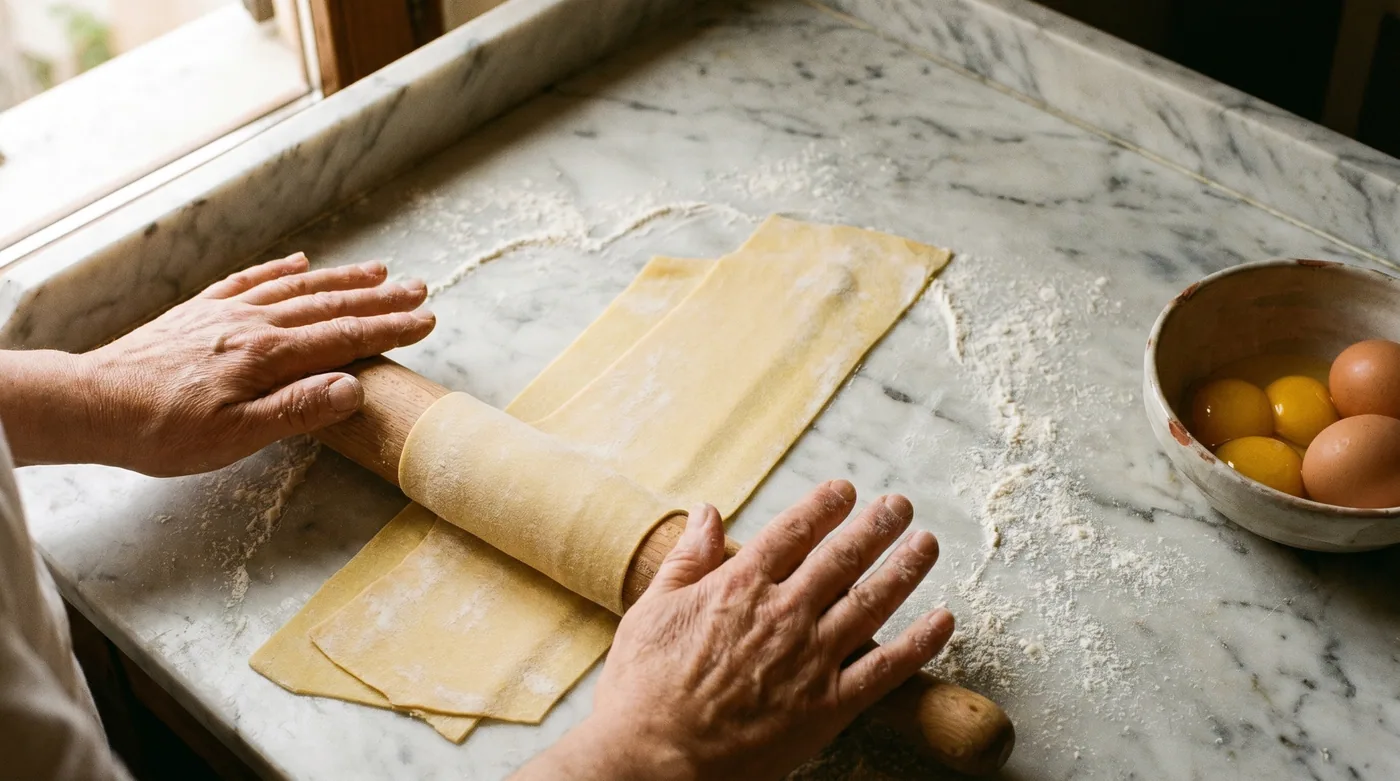
The cuisines diverge from there. Chinese egg noodles get rolled thin and cut into long strands (or pre-fried for shelf stability). American egg noodles get rolled flat and cut into wide ribbons or short curls. German Spätzle skip rolling entirely — the dough is wet enough to scrape directly into boiling water, where it forms irregular blobs. Same family, three completely different production paths.
A short history across three cuisines
The egg-noodle idea didn't travel as a single tradition — it appears to have emerged independently in China, central Europe, and (later) the American colonies, then evolved on parallel tracks for centuries.
China — the oldest documented line. Wheat noodles appear in Chinese texts from the Han dynasty (~200 CE), and egg-enriched variants are referenced in southern Chinese cooking by the Song dynasty (960-1279 CE). The southern Chinese egg-noodle line — yellow, thin, springy — became the ancestor of every Cantonese and Fujianese descendant: lo mein (stir-fried with sauce), chow mein (pre-fried and crisped), wonton mein (in clear broth with dumplings), and hokkien mee (the thicker Southeast Asian variant carried by Hokkien Chinese diaspora to Singapore, Malaysia, and Indonesia). Cantonese immigrants exported the format worldwide in the 19th and 20th centuries, which is why the word chow mein now means a recognizable dish in Lima, Lagos, and Liverpool.
Germany — Spätzle and the Swabian lineage. German egg-noodle history is best documented from the 16th century in the Swabian region of southwestern Germany, though earlier references exist. Spätzle (SHPETS-luh) means "little sparrow" in Swabian dialect — a nickname for the irregular bird-shaped lumps the wet dough forms when scraped into boiling water. By the 1700s Spätzle had spread across southern Germany, Austria, Hungary (as nokedli), and Switzerland (where the cheese-and-onion baked version Kässpätzle became canonical). Spätzle is the only major egg-noodle tradition that skips rolling and cutting entirely — the dough is too wet to handle, by design.
America — Pennsylvania Dutch and the commercialization of the dry noodle. German-speaking immigrants from the Rhineland and Palatinate regions began settling Pennsylvania in the late 1600s and through the 1700s. They brought the European egg-noodle tradition with them, and over generations it stabilized into the Pennsylvania Dutch homestyle: flat ribbons rolled by hand, dried on racks, used in chicken pot pie (bot boi), buttered-noodle sides, and chicken-noodle soup. The commercial era arrived in 1949, when Reames Foods began commercial frozen egg-noodle production in Marshalltown, Iowa — still the brand that anchors the Midwestern home pantry. No Yolks (a low-cholesterol version using only egg whites in the dough) launched in 1976 under Foulds Inc. Pennsylvania Dutch Noodles, owned by New World Pasta, remains the canonical dry-aisle brand.
Three lineages, three different definitions of what an "egg noodle" should look like — but the wheat-and-egg core is the same.
The five main egg-noodle styles
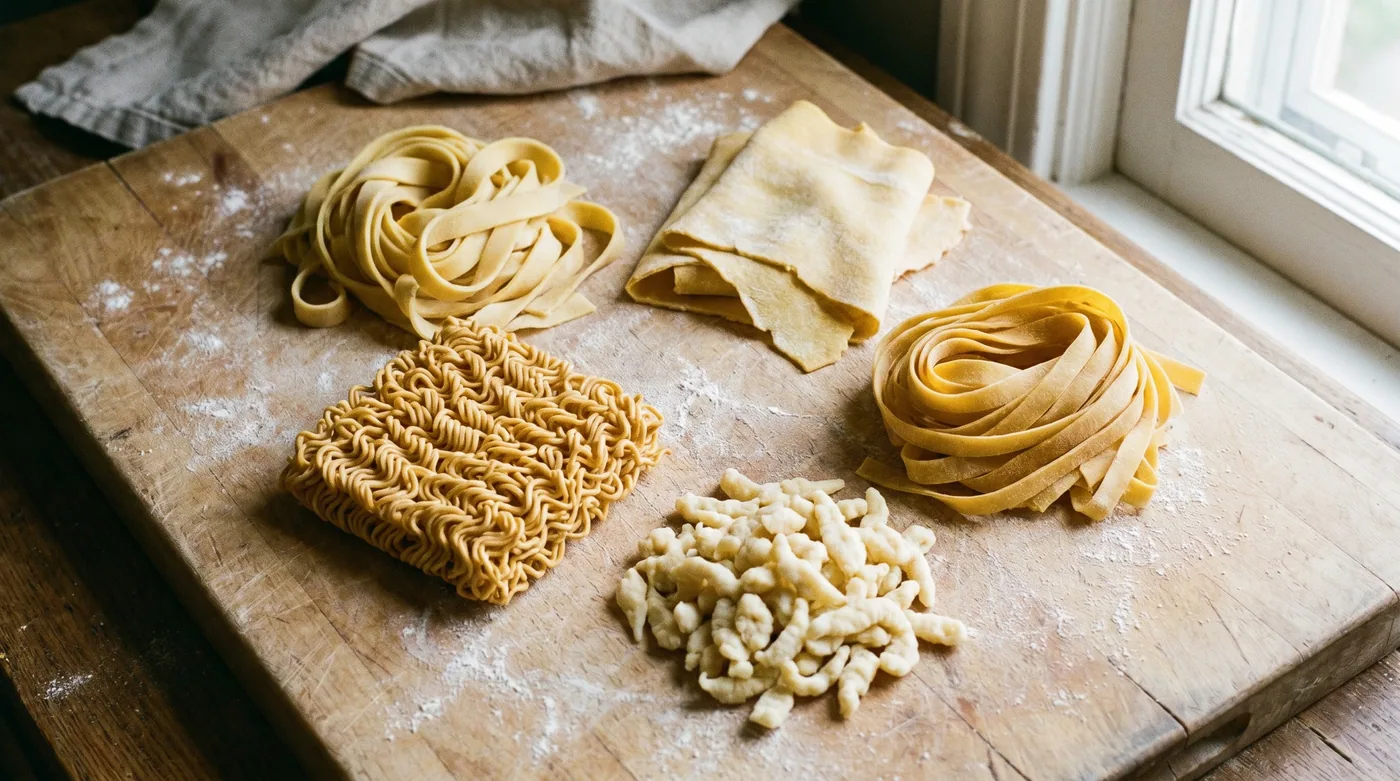
Each style below is a recognizably distinct product in its own grocery aisle. Knowing which one a recipe calls for matters; they don't substitute one-for-one.
| Style | Origin | Format | Width | Where to find it |
|---|---|---|---|---|
| Chinese fresh egg noodles | Cantonese / Hong Kong | Refrigerated, often coiled in nests | ~2mm thin, round or flat | H Mart, 99 Ranch, Chinatown groceries |
| Chinese dry egg noodles (chow mein) | Cantonese, US-diaspora | Pre-fried, shelf-stable, wavy | ~2mm thin, curly | Asian grocery + mainstream grocery (Roland, Ka-Me) |
| Hokkien mee noodles | Fujian / Singapore / Malaysia | Yellow round noodles, sometimes fresh, sometimes vacuum-packed | ~4-5mm round | Southeast Asian grocery, larger H Marts |
| American Pennsylvania Dutch dry | Pennsylvania, US | Shelf-stable dry, flat ribbons | ~1cm wide (extra-wide), narrower cuts also sold | Walmart, Kroger, Publix — mainstream pasta aisle |
| German Spätzle | Swabia, southwestern Germany | Hand-scraped wet dough or dried packaged | Irregular, bird-shaped lumps | German specialty grocers, Whole Foods, Amazon |
Chinese fresh egg noodles are the canonical lo mein and wonton-noodle base. Sold refrigerated in 1-pound coils at Asian groceries. Boil 2-3 minutes, then drain into a stir-fry or broth. The deep yellow comes from kansui plus egg working together.
Chinese dry egg noodles are pre-fried during manufacturing, which drives out moisture and produces a 12-month shelf life and a wavy curl. These are the noodles for chow mein — pan-fried until crisp, then sauced. Roland and Ka-Me sit in the mainstream Asian aisle at most US supermarkets.
Hokkien mee noodles are thicker, rounder, and yellower than the Cantonese version — the alkaline content runs higher, which produces the springy bite that holds up to wok-frying. Singapore and Malaysian menus sometimes call them yellow noodles. Outside Asian groceries they're hard to find; thicker Italian egg fettuccine is the nearest US substitute, and it isn't very close.
American Pennsylvania Dutch dry is the wide flat ribbon the US Midwest grew up on. Wide runs about 1cm; extra-wide runs slightly wider; kluski (a Polish-influenced cut) is shorter and thicker. Texture is softer than Italian pasta, color is paler (no kansui), cook time is 6-8 minutes versus 10-12 for dry pasta of similar thickness.
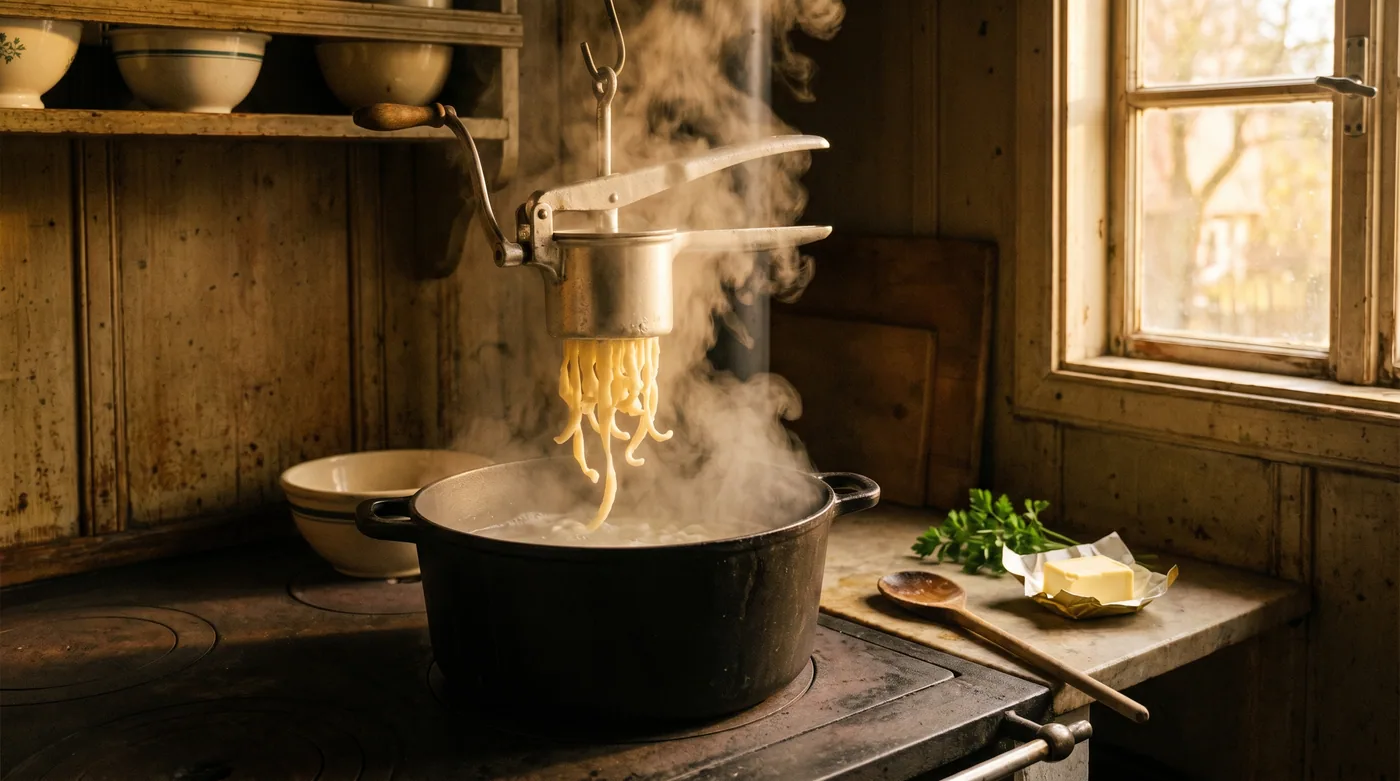
German Spätzle is the outlier — dough wet enough to flow, somewhere between thick pancake batter and bread dough. Traditional preparation uses a Spätzle press (a slotted board the dough is scraped across with a knife) directly over a pot of boiling water. Cook time runs 60-90 seconds. Dried packaged versions from Bechtle and Müller's exist but lose the airy, irregular texture. Spätzle is usually served as a side with browned butter, or baked with cheese as Käsespätzle (KEH-zuh-shpets-luh).
Egg noodles vs pasta — the actual differences
This is where most US shoppers get confused. The short version: all egg noodles are noodles, but not all noodles are pasta — and most pasta is not made with egg.
Italian pasta, by tradition and by law, is wheat semolina (durum-wheat flour) plus water. The dry pasta sold in Italian supermarkets must follow Italian government regulations dating to 1967 — for pasta secca (dry pasta), durum semolina is the only flour permitted, and egg is forbidden in the standard category. Pasta all'uovo (egg pasta) is a separately regulated category, mostly applied to fresh pasta, where at least 200g of egg per kilogram of semolina is required. Italian pasta is not casually egg-enriched the way American or Chinese egg noodles are.
The canonical Italian egg pastas are mostly ribbons:
- Pappardelle (pop-pa-DELL-ay) — 2-3cm wide, the canonical pairing for braised meat sauces
- Tagliatelle (tahl-yah-TELL-ay) — 6-8mm wide, the Bolognese standard
- Fettuccine (fet-too-CHEE-nay) — 4-6mm wide, the Roman cream-sauce ribbon
- Tagliolini (tahl-yo-LEE-nee) — 2-3mm wide, the delicate broth noodle
In every other respect, the differences come down to dough composition and cuisine:
- Pasta (in the Italian sense): wheat semolina + water, dried at low temperature for weeks in the traditional process, eaten with structured sauces, cooked to al dente in heavily salted water.
- Egg noodles (in the broader sense): wheat flour + eggs + water + salt, cooked faster, often softer, used across stir-fries, soups, casseroles, and butter sides.
A reasonable US shopper rule: if the package says pasta and lists semolina or durum wheat without egg, it's Italian-tradition pasta. If it says egg noodles and lists eggs in the top three ingredients, it's the broader egg-noodle family — Chinese, American, German, or the Italian all'uovo sub-category. The cuisines are connected but not interchangeable.
Are egg noodles healthy?
The honest answer is that they're a refined-grain carbohydrate with a small nutritional upgrade from the egg, not a health food and not a junk food. Most US-labeled dry egg noodles come in around these numbers per 100g cooked, per USDA FoodData Central:
| Nutrient | Per 100g cooked (typical dry egg noodle) |
|---|---|
| Calories | ~138 kcal |
| Carbohydrates | ~25g |
| Protein | ~4.5g |
| Fat | ~2g |
| Saturated fat | ~0.4g |
| Cholesterol | ~5mg |
| Sodium | ~5mg (un-salted cooking water) |
| Fiber | ~1.2g |
Compared with a 100g cooked serving of plain durum pasta — roughly 131 kcal, 25g carbs, 5g protein, 1g fat, 0mg cholesterol — egg noodles run modestly higher in fat and contain a small amount of cholesterol from the yolk. Protein is roughly comparable; some egg-noodle products run slightly higher, some slightly lower, depending on egg-to-flour ratio.
The egg adds nutritional value the pasta doesn't have. Egg yolks contribute small but non-trivial amounts of vitamin A, vitamin D, riboflavin, vitamin B12, choline, and selenium. None of those numbers turn egg noodles into a health food — they're still refined-grain carbohydrates — but the strand is meaningfully more nutrient-dense than the same weight of pure-wheat pasta.
The single biggest nutrition difference between egg-noodle products is the sodium when served as instant or seasoned soup. Plain dry egg noodles are very low-sodium (5-10mg per 100g cooked). Add a seasoning packet, a canned broth, or store-bought stroganoff sauce and that number can jump 20-fold. The noodle itself isn't the sodium problem; the sauce usually is.
For shoppers tracking cholesterol specifically: No Yolks is the recognizable US product built to address this. It uses egg whites only — same wheat base, same texture profile as a Pennsylvania Dutch wide noodle, with cholesterol dropped to effectively zero. It's the standard recommendation when a recipe calls for egg noodles but the cook is on a cholesterol-restricted diet.
Are egg noodles gluten-free?
No. Traditional egg noodles — Chinese, American, German, Italian all'uovo — are built on wheat flour, which contains gluten. Wheat is the structural base; the egg is the enrichment. Without wheat (or another gluten-containing grain), the dough doesn't form the elastic network that holds a noodle together at the cooked weight.
Gluten-free egg noodles exist as a separate product category. Jovial makes a gluten-free egg pasta using brown rice flour and whole eggs. King Soba makes a rice-noodle line that includes egg-enriched variants. Manischewitz's gluten-free egg-noodle product uses a tapioca-and-potato-starch base with egg for structure, and it's the standard option for Passover egg-noodle cooking under gluten-free or kosher-for-Passover requirements.
These GF versions cook differently than wheat egg noodles. They're more fragile, hold up worse under stir-fry heat, and turn gummy if over-cooked by even 30 seconds. They work best in soups, simple butter preparations, and oven-baked dishes where the noodle isn't stressed. Treating them like Italian egg pasta in a stovetop pan will usually fail.
A note on naming: some Asian-grocery rice-flour noodles are labeled egg noodles on the English packaging even when no egg is involved. The word mein (麵) in Chinese refers to wheat noodles broadly, and translation conventions are loose — some manufacturers use egg noodle as an English approximation of yellow noodle. Check the ingredient list, not the front of the package.
Where to buy egg noodles in the US
The US egg-noodle market sorts into four shelves. Knowing which shelf has what saves grocery-aisle confusion.
The frozen aisle — Reames Foods. Reames homestyle egg noodles anchor the freezer pasta section at Walmart, Kroger, Hy-Vee, Meijer, and most Midwestern regional chains. They come in three cuts (homestyle wide, dumpling-style flat, fine egg noodle). Texture sits closer to fresh — thicker and chewier — because they're never fully dehydrated. A 12-ounce bag runs $3.50-$5.50 depending on metro. The Midwestern default for chicken noodle soup and beef stroganoff.
The dry pasta aisle — Pennsylvania Dutch and No Yolks. Pennsylvania Dutch Noodles (New World Pasta) and No Yolks (Foulds Inc.) sit shoulder-to-shoulder on the dry pasta shelf at nearly every US supermarket. Pennsylvania Dutch is the traditional version with whole egg; No Yolks is the egg-white version with effectively zero cholesterol. Both cost $2.50-$4 for a 12-ounce box.
The Asian grocery refrigerated case — fresh Chinese egg noodles. H Mart, 99 Ranch Market, Patel Brothers (for the Hakka noodle variant), and independent Chinatown groceries carry fresh egg noodles in 1-pound refrigerated coils. Common labels: Hong Kong-style pan-fry noodles, wonton noodles, lo mein, thin egg noodles. A coil runs $2.50-$4. Genuine article for Lo Mein (Chinese egg noodle stir-fry) and Chow Mein (Chinese fried egg noodles).
Specialty / Whole Foods / Amazon. Hakubaku sells organic dry Chinese-style egg noodles at Whole Foods and on Amazon. German Spätzle from Bechtle and Müller's lives in the international section at Whole Foods, larger Wegmans stores, and on Amazon. Italian pasta all'uovo from Rana, Buitoni, and Cipriani sits in the refrigerated or premium dry-pasta sections at most US chains.
For deeper buying-side context, see the Best Chinese Wheat Noodles buying guide, which covers fresh and dry egg-noodle picks alongside the broader Chinese wheat-noodle category.
Common mistakes when cooking egg noodles
Three recurring issues account for almost every disappointing bowl.
Over-boiling. Egg noodles cook faster than Italian pasta — sometimes by half. American dry egg noodles want 6-8 minutes; Italian pappardelle and tagliatelle want 3-4 minutes for fresh, 6-7 minutes for dry; Chinese fresh egg noodles want 2-3 minutes; German Spätzle wants 60-90 seconds. Following a pasta-package convention of "10-12 minutes" turns the egg noodle into mush before it ever sees the sauce. Set the timer 2 minutes shorter than instinct and taste early.
Treating dry chow mein like Italian pasta. Pre-fried Chinese dry egg noodles aren't designed to soak in sauce the way Italian pasta does — they're designed to absorb flash heat in a wok or pan, soften slightly, and crisp. Boiling them limp and then dressing them in a tomato sauce produces something that's neither chow mein nor pasta. If the package shows wavy curly noodles in a clear wrapper from an Asian-brand supplier, treat them as a stir-fry component, not a boiled noodle.
Confusing fresh and dry at the grocery. Fresh Chinese egg noodles cook in 2-3 minutes; dry chow mein noodles cook in 8-10 minutes or fry directly from the package depending on the dish. Buying one and following the other's recipe is the most common Chinatown-aisle mistake. Fresh comes refrigerated in clear plastic and feels soft. Dry comes shelf-stable in a paper or plastic outer box and feels brittle.
A fourth, smaller mistake: salting cooking water to Italian-pasta levels. The canonical one tablespoon per gallon can overwhelm the egg flavor in Chinese or German preparations. Half that works better for most non-Italian egg noodles.
If you only remember one thing
Egg noodles aren't a single noodle — they're a three-cuisine family bound together by one ingredient. Chinese egg noodles are restaurant-and-stir-fry-first, springy from kansui, sold fresh or pre-fried. American egg noodles are home-and-soup-first, soft and flat, sold dry or frozen. German Spätzle is the outlier — wet dough, scraped not rolled, eaten with butter or cheese. The egg ties the family together; the cuisines do everything else differently.
Read next
- Lo Mein (Chinese egg noodle stir-fry)
- Chow Mein (Chinese fried egg noodles)
- Best Chinese Wheat Noodles
- Rice Noodles Explained — the rice counterpart