Egg Noodles vs Pasta in 2026: Which Wins Your Dinner
Compare egg noodles and semolina pasta by egg content, cook time (3-7 vs 8-12 min), and best dishes. Pick the right strand for your soup, stir-fry, or sauce.

Egg noodles and pasta look like the same thing at the grocery — bagged dry noodles, wheat-flour base, sold by the pound. They're not. The single ingredient that separates them (whole eggs in the dough) cascades into everything: texture, color, cooking time, nutritional profile, and the cuisines that built dishes around each. Here's the actual difference, side-by-side, with the one caveat that complicates everything.
TL;DR — The headline difference
Egg noodles include whole eggs in the dough. Standard Italian pasta doesn't.
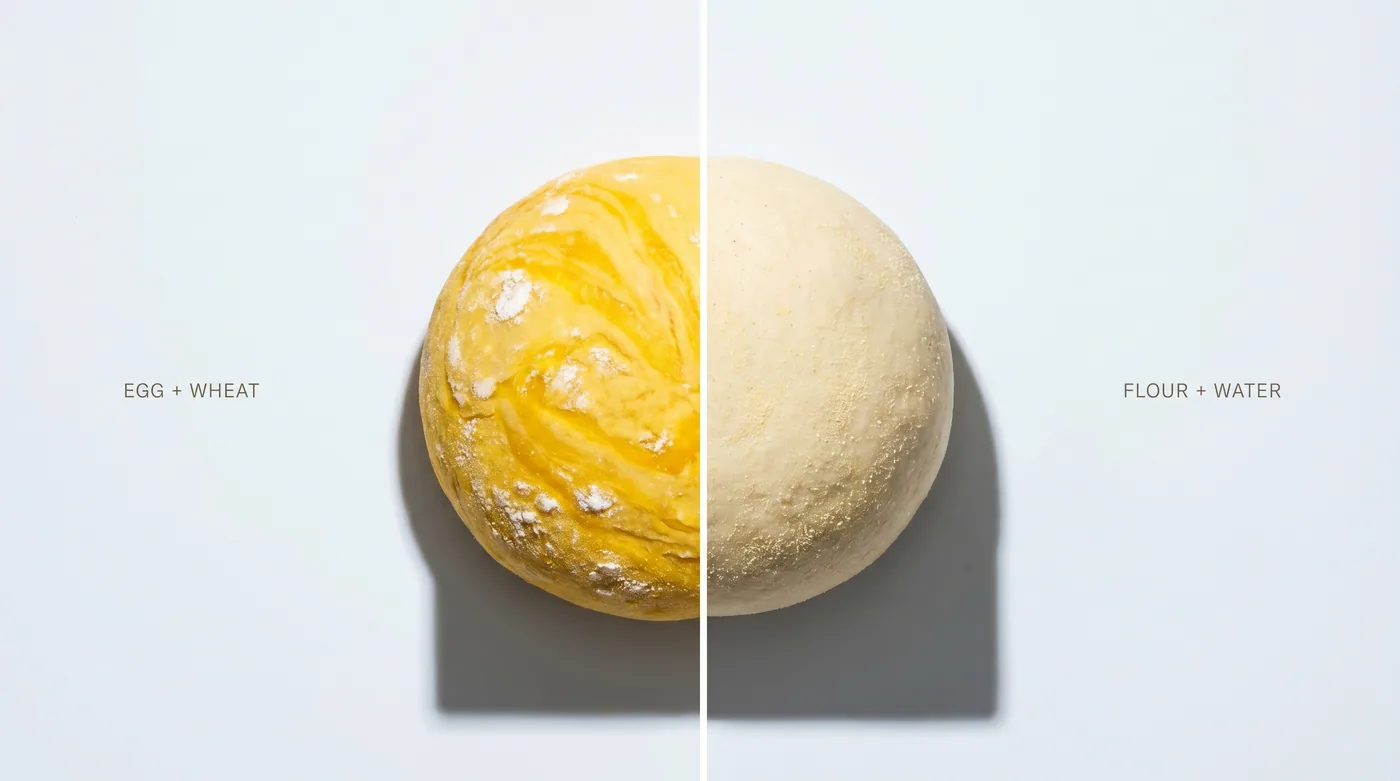
That single ingredient distinction drives most of what follows. Egg noodles (American Pennsylvania Dutch, Chinese lo mein, Eastern European kluski, German Spätzle, Italian pasta all'uovo) all share a wheat-plus-eggs base. Standard dry Italian pasta — the blue-box spaghetti and penne that dominate US grocery shelves — is durum wheat semolina plus water. No eggs.
The cascade: eggs add fat (richness), color (yellow), and they soften the gluten structure (more tender bite, faster cook). Dry semolina pasta builds toward firm al dente; egg noodles build toward tender and absorbent. They aren't interchangeable in dishes that depend on the texture.
The catch — and the part of this comparison most articles get wrong — is that the "pasta vs egg noodle" line isn't actually clean. Pasta all'uovo (Italian egg pasta — tagliatelle, pappardelle, fettuccine, fresh ravioli wrappers) is itself an egg noodle by ingredient. The honest comparison is dry semolina pasta vs egg noodles, not pasta vs egg noodles as whole categories.
The ingredient difference
Three product categories, three ingredient lists:
| Product | Ingredients | Egg content |
|---|---|---|
| Egg noodles (American, Chinese, Eastern European) | Wheat flour + whole eggs + water + salt | High (3-5 eggs per pound of flour typical) |
| Dry pasta (standard Italian, blue-box) | Durum wheat semolina + water | None |
| Pasta all'uovo (Italian fresh egg pasta) | Durum semolina + whole eggs | 5-7 eggs per kg of flour (Italian DOP regulated) |
The first column is the cleanest divider. American bagged egg noodles (Pennsylvania Dutch Noodles, No Yolks, Manischewitz) list eggs as the second ingredient after wheat flour. Standard dry Italian pasta (Barilla, De Cecco, Rummo) lists only durum wheat semolina and water. Both products sit in the same grocery aisle, often within arm's reach of each other, but they're built from different starting points.
Pasta all'uovo — the Italian fresh egg-pasta tradition centered in Emilia-Romagna (Bologna, Modena, Parma) — is regulated. Italian DOP standards require 5-7 whole eggs per kilogram of flour for products marketed as fresh egg pasta. Tagliatelle al ragù bolognese, pappardelle al cinghiale, lasagna sheets from a fresh-pasta shop — all of these are egg pasta. They're called pasta because they're Italian. But their ingredient list is closer to American egg noodles than to dry spaghetti.
The honest comparison is dry semolina pasta vs egg noodles — not "pasta" vs "egg noodles" as whole categories. Italian pasta all'uovo IS egg pasta.
Texture comparison
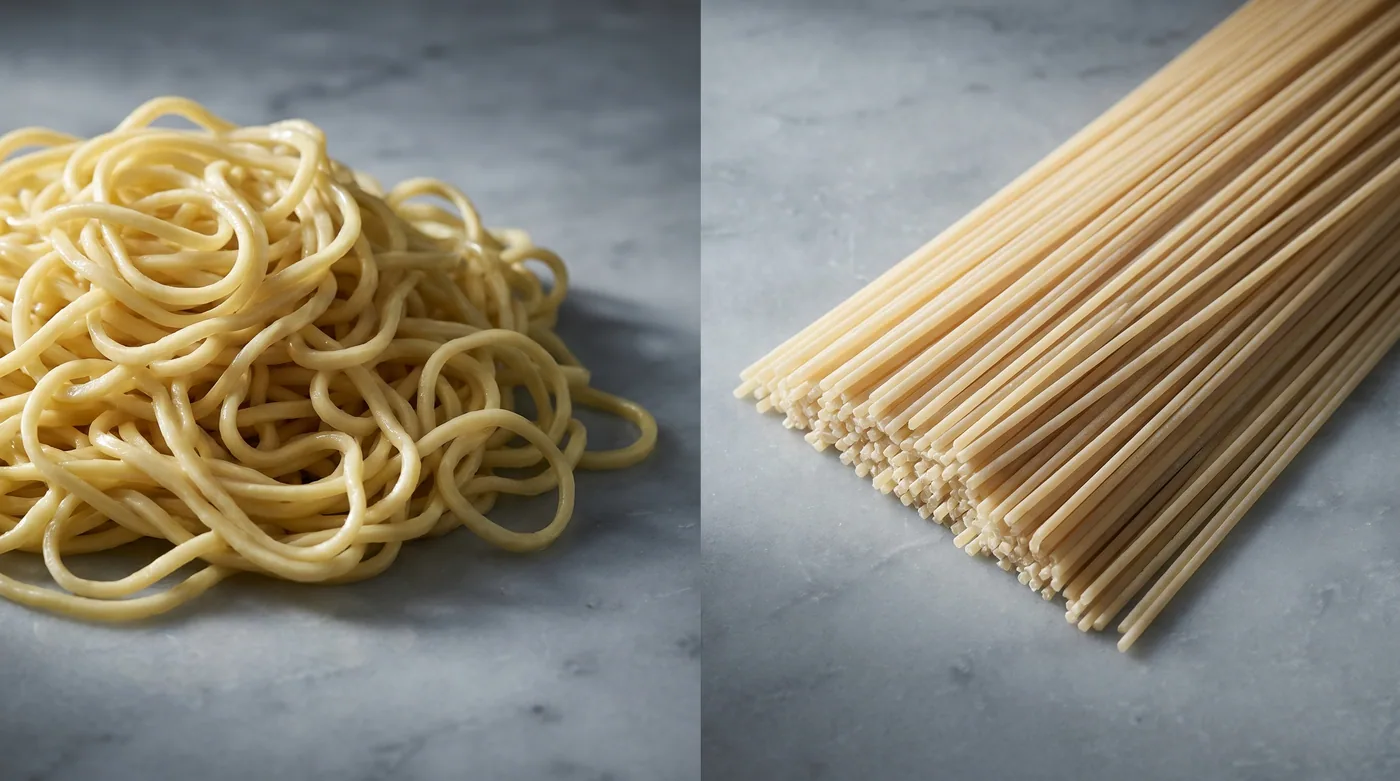
Egg changes the noodle's bite in three measurable ways:
- Fat from the yolk adds richness and mouthfeel. The cooked noodle tastes fuller, less stark, more comforting.
- The egg yolk's color turns the noodle pale yellow. Pennsylvania Dutch egg noodles, Chinese lo mein, Italian fresh tagliatelle — all visibly yellower than dry spaghetti.
- Fat and protein from the yolk interfere with gluten development. This is the biggest structural difference. Gluten is the elastic protein network that gives bread its chew and pasta its al dente bite. When you add fat-rich eggs to a wheat dough, the fat coats the gluten proteins and prevents them from forming long elastic chains. The dough becomes more tender, less elastic — which translates to a noodle that's softer, more absorbent, less resistant to the tooth.
Standard dry pasta is the opposite. Durum wheat is one of the highest-protein wheats grown (13-15% protein vs 10-12% in standard bread wheat), and the semolina grind preserves the protein structure. Combined with no fat to interfere, dry pasta develops the tight gluten network that creates classic Italian al dente — firm to the bite, with a slight resistance and chew that pushes back against the sauce.
The practical result: egg noodles never reach Italian pasta's bite. They're built for a different texture goal. Dishes that depend on al dente firmness (carbonara, aglio e olio, dry pasta tossed with olive oil) lose their core identity when you substitute egg noodles. Dishes that depend on softness and absorbency (chicken noodle soup, beef stroganoff, Pennsylvania Dutch buttered noodles) lose their core identity when you substitute dry pasta.
Cooking time
The texture difference shows up in the pot:
| Product | Cook time |
|---|---|
| Egg noodles (American bagged, ~1/4 inch wide) | 3-7 minutes |
| Chinese fresh lo mein noodles | 2-4 minutes |
| Italian pasta all'uovo (fresh tagliatelle, pappardelle) | 2-4 minutes |
| Dry semolina pasta (spaghetti, penne, rigatoni) | 8-12 minutes |
| Dry semolina pasta, thick/dense shapes (rigatoni, paccheri) | 12-15 minutes |
Egg noodles cook faster for two reasons. First, the looser gluten network lets water penetrate faster — there's less elastic protein structure to fight through. Second, egg noodles are often thinner and rolled flatter than dry pasta shapes, which shortens cook time independently.
The 5-minute gap between egg noodles and pasta is the most common substitution mistake. Cooks who swap one for the other without adjusting timing end up with mush (overcooked egg noodles in a pasta-time recipe) or undercooked starchy pasta (dry pasta in an egg-noodle-time recipe). Treat them as separate ingredients with separate timing — they're not the same thing in shorter or longer form.
Nutritional comparison
Per 100g cooked, the three product categories look like this:
| Nutrient | Egg noodles | Dry semolina pasta | Pasta all'uovo (fresh) |
|---|---|---|---|
| Calories | ~138 | ~131 | ~145 |
| Carbohydrates | 25g | 25g | 24g |
| Protein | 4.5g | 5g | 5.5g |
| Fat | 2g | 1g | 2.5g |
| Cholesterol | ~5mg | 0mg | ~7mg |
| Sodium | 5mg | 1mg | 8mg |
(Values are USDA averages cross-referenced with major brand nutrition panels; expect ±10% variation between specific brands.)
The differences are small. Egg noodles add roughly 7 calories per 100g over dry pasta — within the rounding error of a standard meal. The fat is doubled (2g vs 1g), and the cholesterol jumps from zero to about 5mg per 100g (from the egg yolk). Protein is slightly lower in egg noodles than in dry pasta because durum wheat semolina is the higher-protein starting material.
Egg noodles are not dramatically less healthy than pasta. Marketing copy on both sides exaggerates the gap. The factors that matter for the meal's nutrition are portion size, sauce composition, and what protein and vegetable accompany the dish — not the 7-calorie difference between the two noodle types.
The exception worth noting: people managing dietary cholesterol or egg allergies should choose dry semolina pasta. Egg noodles contain real egg-derived cholesterol and are an obvious egg allergen. Dry pasta contains neither.
Cuisine context
The biggest practical difference isn't in the ingredients or the texture — it's in the food cultures that built dishes around each noodle.
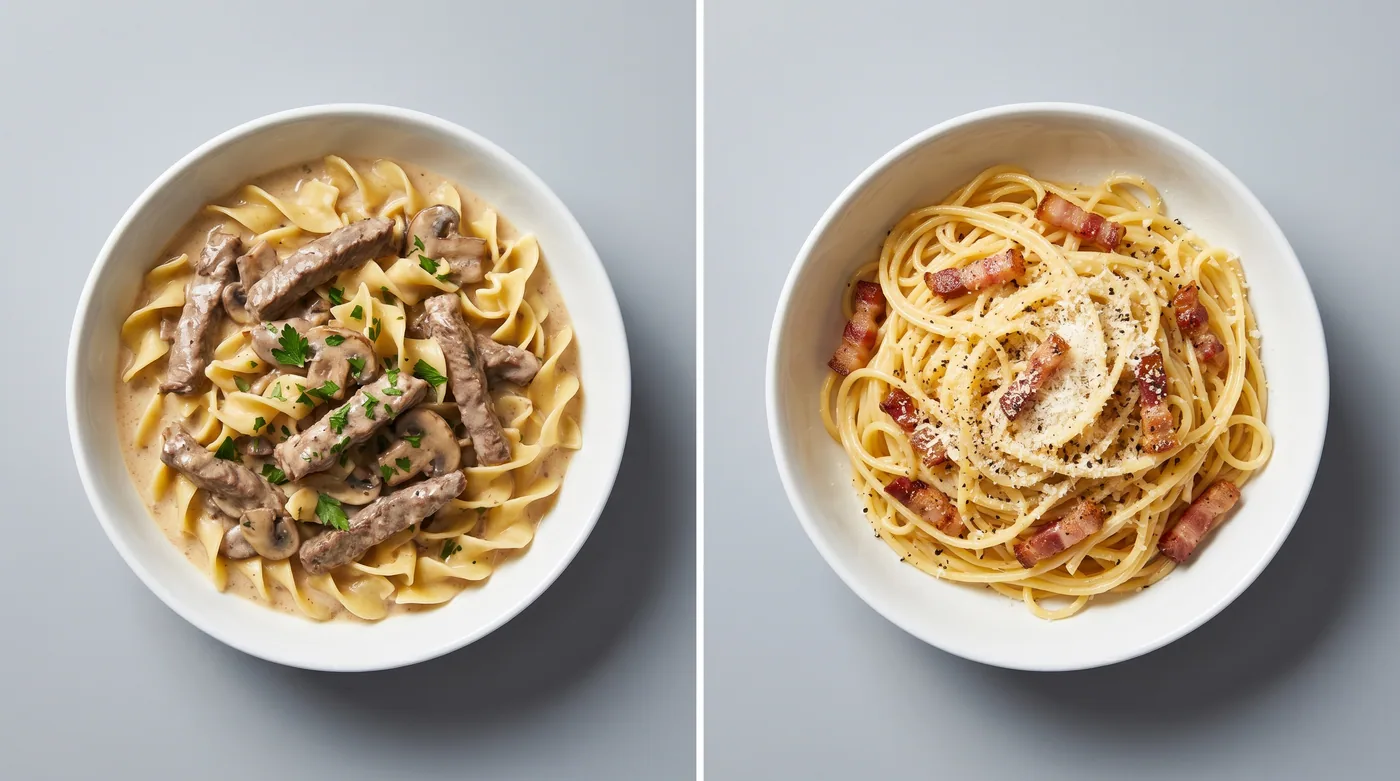
Dry semolina pasta lives in Italian food. Spaghetti carbonara, penne arrabbiata, rigatoni cacio e pepe, baked ziti, lasagna with bechamel — every iconic Italian pasta dish is built around the bite of durum semolina. Italian regional cuisines have developed distinct pasta shapes for distinct sauces (the wide hollow of paccheri for heavy ragùs, the spirals of fusilli for catching pesto, the smooth tube of penne for tomato sauce that needs a vessel). The shape and bite are part of the dish's identity.
Egg noodles live across multiple cuisines simultaneously. Chinese egg noodles power lo mein, chow mein, and Hokkien mee. Eastern European kluski (Polish, Hungarian, Czech) anchor stews and dumpling-adjacent dishes. German Spätzle is a free-form egg dumpling-noodle hybrid served alongside roast meats. American Pennsylvania Dutch buttered noodles, chicken noodle soup, and beef stroganoff all default to bagged egg noodles. And in Italy itself, the entire pasta all'uovo tradition — pappardelle al cinghiale, tagliatelle al ragù bolognese, fresh ravioli — is built on egg noodles even though Italians don't call them that.
This is why "egg noodles vs pasta" can't be answered purely on ingredients. A bowl of pappardelle with wild boar ragù is structurally an egg-noodle dish (eggs in the dough, soft tender bite, designed to absorb the meaty sauce). A bowl of dry spaghetti carbonara is structurally a semolina-pasta dish (no eggs in the noodle, firm al dente bite, designed to resist the sauce coating). Both are "pasta" by Italian convention. Only one is what an American grocery shopper means by "egg noodles."
When to use egg noodles
Egg noodles win when the dish wants softness, absorbency, and richness:
- Chicken noodle soup — the soft egg-noodle bite carries the broth, doesn't fight it. Pasta would be too firm and would keep cooking in the soup pot.
- Beef stroganoff — the rich sour-cream sauce wants a tender noodle that soaks up flavor rather than pushing it away. Egg noodles are the canonical choice.
- Pennsylvania Dutch buttered noodles — wide flat egg noodles tossed in butter and salt. The egg-rich flavor is the dish; substituting pasta would erase the point.
- Chinese stir-fries — lo mein and chow mein both want the springy slightly-soft bite that wheat-and-egg-and-kansui noodles deliver. Italian pasta won't deliver the same texture.
- Hungarian goulash and Eastern European stews — egg-noodle traditions in these cuisines run a thousand years deep. The soft absorbent noodle is part of the dish's structural design.
- Rich braised dishes generally — short ribs, beef cheek, osso buco. The softer noodle catches the sauce instead of bouncing it off.
When to use pasta
Dry semolina pasta wins when the dish wants firmness, structure, and that specific Italian al dente bite:
- Italian dishes specifically — carbonara, aglio e olio, cacio e pepe, amatriciana. These were built around durum wheat. Substituting won't make them taste wrong exactly, but it'll erase the textural identity.
- Baked pasta dishes — lasagna, baked ziti, pastitsio. These cook for 30+ minutes in the oven; only the structural integrity of dry semolina can survive that without turning to paste.
- Pasta salads — cold pasta needs to hold its shape and bite. Egg noodles get mushy when cold; dry pasta stays firm.
- Dishes that need the noodle to push back — oil-based pasta dishes (aglio e olio), light tomato pastas (pomodoro), seafood pastas (vongole). The al dente bite is the contrast that makes the dish work.
- Volume cooking for a crowd — dry pasta holds longer between cooking and serving without breaking down. Egg noodles need to be served closer to immediately.
Can you substitute one for the other?
Yes, but the substitution works better in one direction than the other.
Pasta → egg noodles works reasonably well in soft-noodle contexts. Drop dry pasta into chicken noodle soup, simmer it less than the box says, and you'll get a passable bowl. The texture won't match canonical egg-noodle softness, but the dish still functions.
Egg noodles → pasta in Italian preparations works poorly. Egg noodles overcook in the time most Italian recipes call for, and they don't hold up to high-temperature baking or extended sauce contact. A carbonara made with egg noodles is mush within 90 seconds.
The closest cross-cuisine match is Italian pappardelle ↔ Chinese fresh wide egg noodles. Both are wide flat egg-rich wheat noodles. Both are designed to be served immediately after cooking. Both absorb sauce well. The cultural distance is huge, but the structural match is the tightest in the comparison. A Chinese cook who runs out of fresh lo mein noodles can use Italian pappardelle and the result will be culturally wrong but functionally similar.
The general principle: substitute when the dish wants softness and absorbency. Don't substitute when the dish wants the specific bite of one tradition or the other.
If you only remember one thing
Egg noodles include whole eggs; standard dry pasta doesn't — but Italian pasta all'uovo (fresh egg pasta) is itself egg pasta. The clean comparison is between dry semolina pasta (firm, al dente, Italian-built) and egg noodles (soft, absorbent, multi-cuisine). They're built for different dishes. Egg noodles win in soups, stews, and rich braised dishes. Dry pasta wins in Italian specifically and any dish that needs the noodle to push back against the sauce. The nutritional difference is small enough to ignore for most meals.
FAQ
Are egg noodles the same as pasta? Not quite. The clean line is between dry semolina pasta (no eggs) and egg noodles (eggs in the dough). But Italian pasta all'uovo — tagliatelle, pappardelle, fettuccine — is itself egg pasta. The category "pasta" includes both egg and non-egg traditions.
Are egg noodles healthier than pasta? Marginally different, not dramatically healthier or unhealthier. Egg noodles add ~7 calories and 1g fat per 100g over dry pasta, plus ~5mg cholesterol. Within the noise of a normal meal.
Can I substitute egg noodles for pasta? Pasta → egg noodles works better than the reverse. Egg noodles overcook in Italian pasta dishes; dry pasta is too firm and too slow-cooking for soft-noodle dishes like chicken soup or stroganoff.
What's the difference between egg noodles and spaghetti? Eggs in the dough, flat vs round shape, softer vs firmer bite, faster vs slower cook. Three or four structural differences, not just one.
Are Chinese lo mein noodles the same as Italian egg pasta? Same ingredient family (wheat plus eggs) but lo mein adds kansui (alkaline mineral water) for the springy chew that defines Chinese wheat noodles. Italian egg pasta is softer and more delicate.
Why do egg noodles cook faster than pasta? Egg fat interferes with gluten development, making a more porous tender noodle that absorbs water faster. Egg noodles are also typically thinner. Together: 3-7 minutes vs 8-12 for standard dry pasta.
Read Next
- Egg Noodles Explained (full encyclopedia entry)
- Lo Mein (Chinese egg noodle dish)
- Best Italian Pasta Brands
- Best Chinese Wheat Noodles