Singapore Rice Noodles: The Hong Kong Dish, Explained (2026)
Learn why your "Singapore" noodles come from 1950s Hong Kong — mei fun, Madras curry powder, char siu, shrimp. The real recipe and US Chinatown sources.

If you order Singapore Rice Noodles at a Cantonese restaurant in any US Chinatown, you will eat a Hong Kong dish. Singapore itself has hundreds of noodle traditions — laksa, char kway teow, hokkien mee, mee goreng — and this one is not among them. The dish was invented in Hong Kong in the 1950s-60s, and the Singapore in the name refers to a flavor profile, not a country of origin.
TL;DR
Singapore Rice Noodles is a Cantonese dish from Hong Kong, not Singapore. Thin rice vermicelli (mei fun) stir-fried with Madras curry powder, char siu (Chinese BBQ pork), shrimp, scrambled egg, bean sprouts, peppers, and scallions. The yellow color comes from the curry powder. The dish is virtually unknown in Singapore, where local noodle culture runs in entirely different directions. The name is a Hong Kong-Cantonese shorthand for Southeast Asian curry-powder flavor, applied during the British colonial era when Singapore symbolized the region. That naming irony is the entire story of the dish.
What it actually is
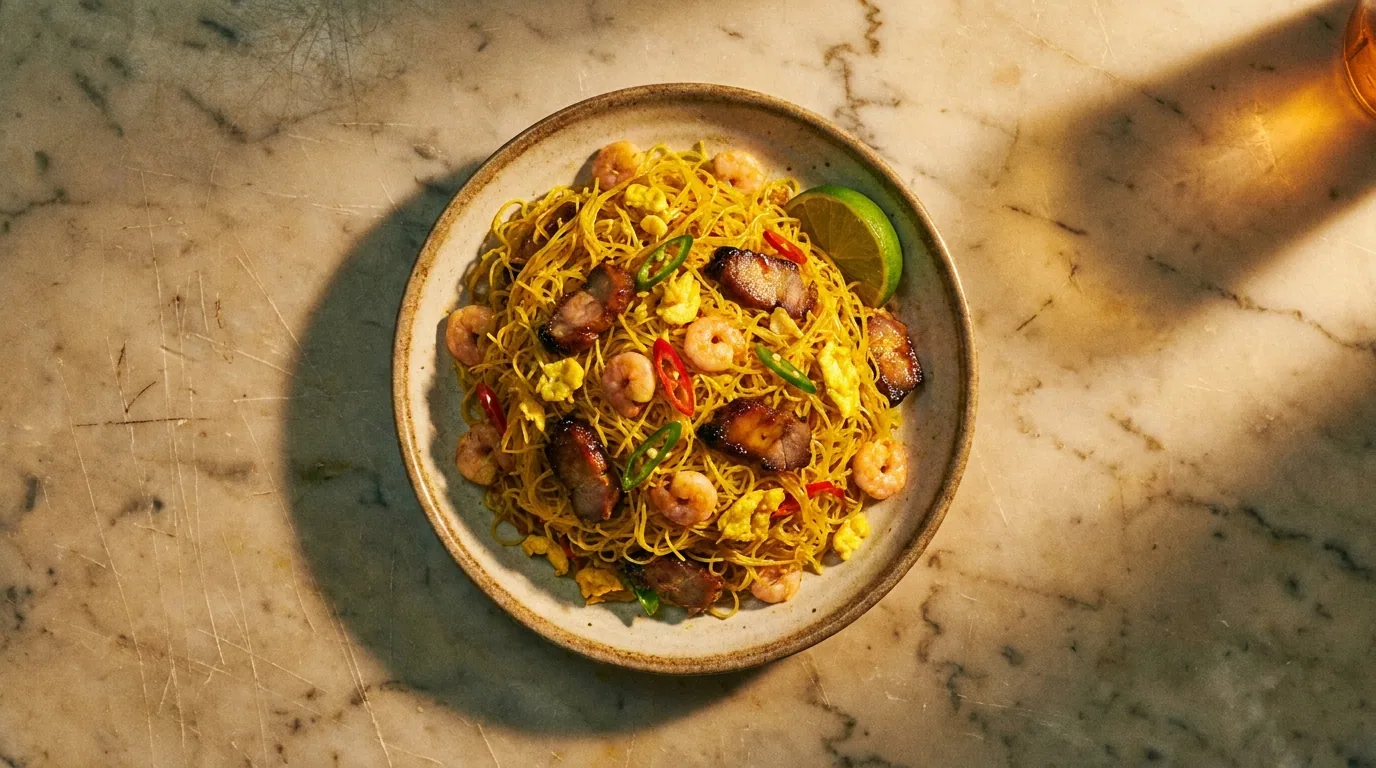
Singapore Rice Noodles is a Cantonese-Hong Kong stir-fry. The base is mei fun (米粉) — thin rice vermicelli, ~1mm in diameter, soaked in warm water for 8-10 minutes until pliable, then tossed in a hot wok. The seasoning is Madras-style yellow curry powder, the kind that British colonial trade spread from India across Southeast Asia in the 19th and 20th centuries. The proteins are char siu (the lacquered red-edged Cantonese BBQ pork) and small peeled shrimp, plus scrambled egg cooked into the noodles. The vegetables are bean sprouts, julienned green and red bell pepper, and scallion. The finish is soy sauce, oyster sauce, and a few drops of sesame oil.
The signature trait is the color. The curry powder coats every strand and turns the dish a saturated yellow that is immediately recognizable across a Cantonese menu. A plate of Singapore Rice Noodles done correctly looks like a yellow tangle of vermicelli with visible chunks of dark-red char siu, pink shrimp, yellow scrambled egg, and bright pepper.
The cooking technique is straight Cantonese stir-fry — high heat, fast wok work, wok hei (the slightly smoky char that comes from a properly seared wok). The dish is not curried in any Southeast Asian sense; the curry powder is dry seasoning, not a sauce or paste. There is no coconut milk, no tamarind, no lemongrass, no shrimp paste. It is a Cantonese stir-fry that happens to be seasoned with curry powder.
Singapore Rice Noodles is what happens when a Cantonese chef in 1950s Hong Kong reaches for a jar of British-colonial Madras curry powder and seasons rice vermicelli with it. The dish is the seasoning choice, not the geography.
The naming story
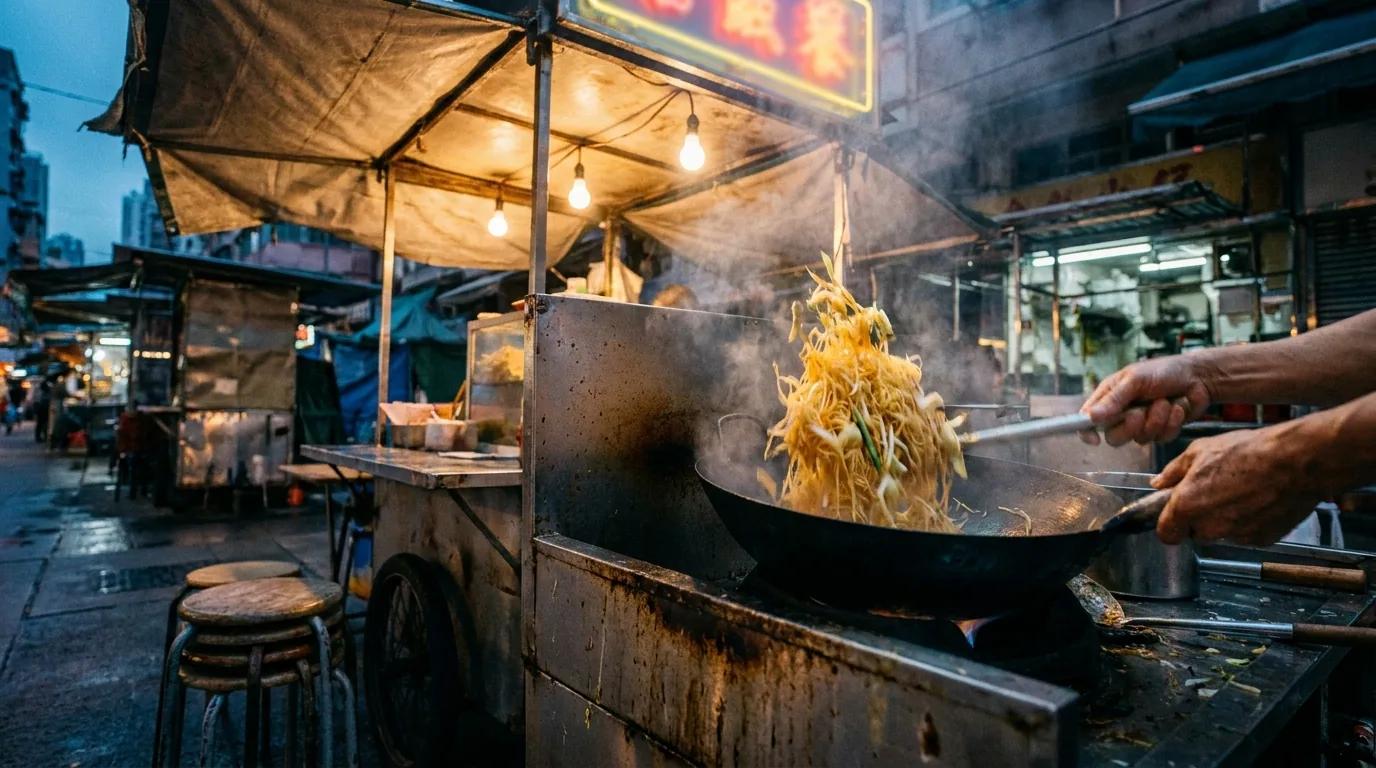
The origin trace points to Hong Kong, sometime in the 1950s or 60s, in the dense Cantonese restaurant districts of Wan Chai and Causeway Bay. The exact restaurant of origin is not documented — Hong Kong food historians generally treat this as a period of restaurant-driven innovation rather than a single inventor — but the naming convention is well understood.
Hong Kong was, at the time, the British colonial trading port. Singapore was the British administrative center for Southeast Asia. The two cities sat at opposite ends of a colonial trade route that moved Indian spices (including yellow Madras curry powder) through Singapore and into Hong Kong's commercial kitchens. To a Hong Kong chef in 1958, Singapore did not mean the noodle traditions of Singaporean home cooks. It meant the yellow curry-powder spice profile that comes through Singapore. Naming a dish Singapore was the same kind of shorthand a Hong Kong cha chaan teng uses when it puts Swiss sauce on the menu for a sweet soy-based glaze that has no connection to Switzerland.
This pattern shows up across Hong Kong-Cantonese restaurant menus. Yangzhou fried rice invokes a city most Cantonese diners have never visited. Hainanese chicken rice references an island most Hong Kong cooks did not learn the dish from. Singapore on a noodle dish in Hong Kong worked the same way: it told the diner this is the curry-powder one. The geographic claim was incidental.
The Madras curry powder is the specific spice anchor — yellow, mild, turmeric-forward, with coriander, cumin, fenugreek, and a touch of chili. It is not Sri Lankan curry (much hotter, raw-spice profile), not Thai red or green curry (paste-based, chili-and-aromatic-driven), not Indonesian rendang (slow-braised, coconut-based). It is the standardized British-colonial yellow curry powder that food companies like Sun Brand and S&B bottled for export across the region.
This is conventional Hong Kong food history. The exact 1950s restaurant of origin is lost; the cultural mechanism behind the name is not.
The standard ingredients
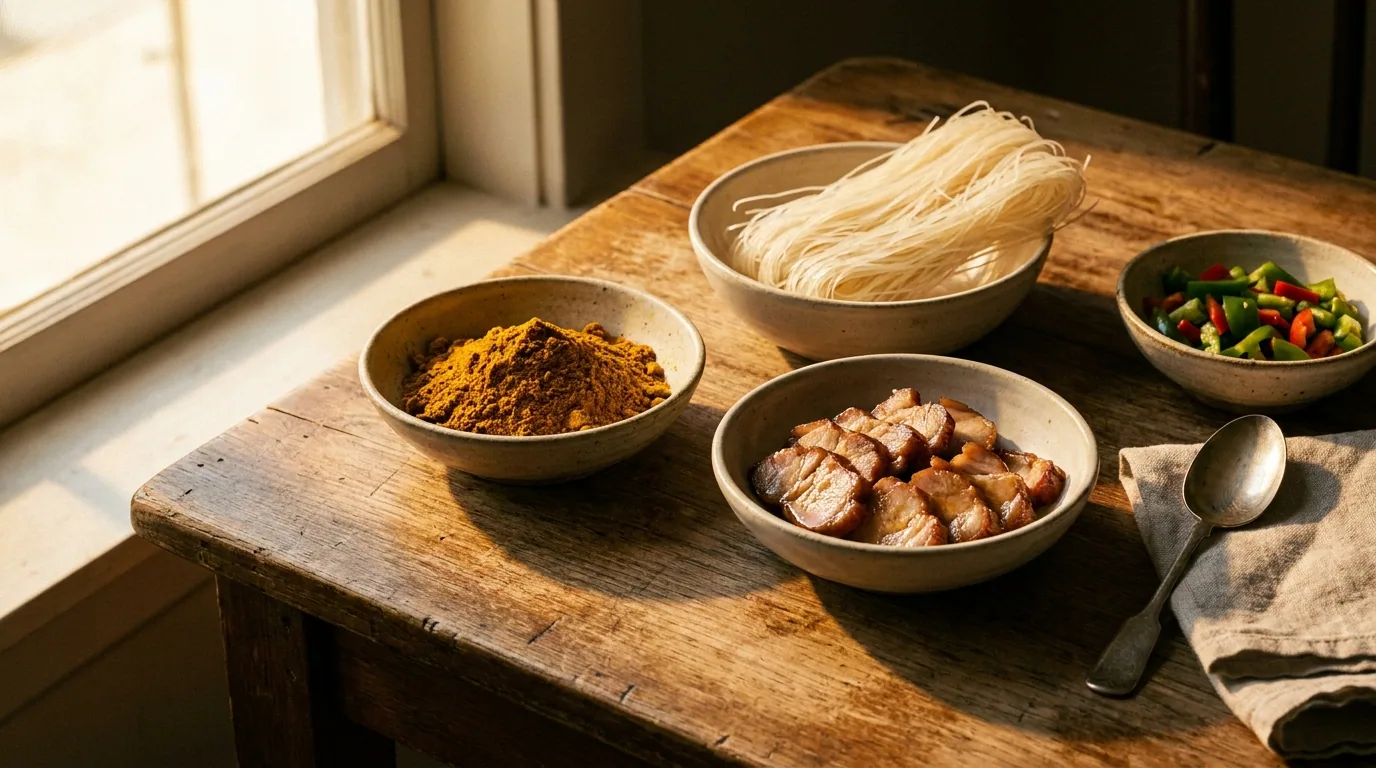
A complete Singapore Rice Noodles build, ingredient by ingredient:
- Rice vermicelli (mei fun / 米粉) — thin dry rice noodles,
1mm diameter. Soaked in warm water 8-10 minutes until pliable. The dominant US grocery brand is Sailing Boat ($2-3 per 400g package at any Chinese grocery). - Madras curry powder — yellow British-colonial-style curry powder. S&B Oriental Curry Powder (the Japanese Madras adaptation, ~$5 at most Asian groceries) is the most common in Hong Kong restaurant kitchens. Sun Brand Madras and McCormick yellow curry powder also work.
- Char siu (叉燒) — Cantonese BBQ pork. The lacquered red-edged honey-soy roast pork sold by weight at every Chinatown roast-meat shop ($12-15/lb). Sliced into matchsticks for the dish.
- Shrimp — small peeled raw shrimp, 50-70 count per pound. Cooked into the noodles, not separately.
- Egg — 1-2 eggs, scrambled into the wok before the noodles go in. The egg cooks into ribbons that distribute through the dish.
- Bean sprouts — fresh mung bean sprouts, added near the end so they stay crisp.
- Bell pepper — green and red, julienned. Color contrast as much as flavor.
- Scallion — sliced on the bias, added at the end.
- Garlic and ginger — minced, into the hot oil first.
- Finishing sauce — light soy sauce, oyster sauce (Lee Kum Kee Premium is the Cantonese standard), a few drops of toasted sesame oil. Some kitchens add a splash of Shaoxing wine.
The ingredient list is short and Cantonese — there is nothing in it that points to Singaporean cuisine. There is no sambal, no belacan, no coconut milk, no curry leaf. The Hong Kong origin shows in every component.
Why it's bright yellow
The curry powder is what makes the dish identifiable on a menu. A plate of char siu, shrimp, and scrambled egg over plain rice vermicelli would not be Singapore Rice Noodles — it would be a generic Cantonese stir-fry. Add curry powder and the dish becomes Singapore Rice Noodles.
The color comes from turmeric, the dominant pigment in Madras curry powder. Turmeric is fat-soluble; the curry powder is bloomed in hot oil at the start of the stir-fry, which releases the turmeric pigment into the oil, which then coats every strand of rice vermicelli as the noodles hit the wok. A correctly cooked plate is uniformly yellow from edge to edge. A plate where the curry powder was added at the end (without the oil-bloom step) will have a streaky, uneven yellow that looks more like dusting than coating.
This is the visual signature that lets you spot the dish at thirty feet across a Chinatown dining room. Yellow vermicelli with red and pink and green chunks through it: Singapore Rice Noodles.
How it's different from pad thai
Western diners sometimes treat Singapore Rice Noodles and pad thai as adjacent rice-noodle dishes. They are not adjacent. They share a starch category (rice noodle) and a cooking method (stir-fry) and almost nothing else.
| Aspect | Singapore Rice Noodles | Pad Thai |
|---|---|---|
| Cuisine | Cantonese / Hong Kong | Thai |
| Noodle | Thin rice vermicelli (mei fun, ~1mm) | Flat rice noodles (sen lek, ~3-5mm wide) |
| Seasoning anchor | Madras curry powder | Tamarind paste + fish sauce + palm sugar |
| Color | Bright yellow (turmeric) | Brown-orange (tamarind) |
| Standard proteins | Char siu + shrimp + egg | Tofu + shrimp + egg |
| Garnish | Bean sprouts, peppers, scallion | Bean sprouts, crushed peanuts, lime wedge, raw chive |
| Finishing acid | Optional fresh lime squeeze | Lime wedge served with every plate |
| Heat profile | Mild (curry powder is mild) | Mild-to-moderate (chili flake at table) |
| Country of invention | Hong Kong, 1950s-60s | Thailand, codified as a national dish in the 1930s-40s |
The two dishes occupy completely different culinary traditions. Singapore Rice Noodles is the Cantonese curry-powder stir-fry. Pad thai is the Thai tamarind-and-fish-sauce stir-fry. Confusing them is a category error.
What "real" Singapore rice noodles looks like at a Cantonese restaurant
A properly executed plate of Singapore Rice Noodles has six visual cues:
- Uniform yellow vermicelli. Every strand is coated. No white patches, no streaks.
- Visible char siu. Pink-edged matchsticks of BBQ pork distributed through the noodles. If you cannot see char siu, the kitchen substituted regular pork or skipped it — a fail.
- Whole small shrimp. Pink, peeled, cooked through but not dried out. Usually 6-10 per plate at a US Chinatown restaurant.
- Egg ribbons. Yellow ribbons of scrambled egg threaded through the noodles, not a separate egg portion on top.
- Crisp bean sprouts and pepper. The vegetables should still have bite. Soft, overcooked vegetables mean the wok wasn't hot enough or the dish sat too long before service.
- Slightly oily, not soaked. The noodles should glisten. They should not pool oil at the bottom of the plate.
Taste profile: curry powder hits the front of the palate (turmeric, coriander, faint chili warmth), soy sauce and oyster sauce bring the umami in behind it, sesame oil ties the finish. The texture should be dry-tossed — every strand separate, none clumped, none gummy. A squeeze of fresh lime at the table sharpens the curry. That is the dish.
If the noodles are wet, gummy, brown instead of yellow, or missing char siu, the kitchen took shortcuts. Walk down the block to the next Cantonese restaurant.
Where to find it in the US
Singapore Rice Noodles is on the menu at virtually every Cantonese restaurant in every US Chinatown:
- Manhattan Chinatown — Wo Hop (17 Mott St), Great NY Noodletown (28 Bowery), Joe's Shanghai (46 Bowery) and most of the Mott and Bayard Street Cantonese spots.
- Flushing, Queens — the Hong Kong-style cafés on Main and Roosevelt — Hong Kong Station, the Cantonese roast-meat houses, the cha chaan teng spots like Mei Lai Wah's Flushing locations.
- San Francisco Chinatown — R&G Lounge, Hing Lung Company, Yong Kee Rice Noodles.
- LA San Gabriel Valley — Sea Harbour, Lunasia, Newport Tan Cang Seafood, and the broader Monterey Park / Alhambra / Arcadia Cantonese restaurant belt.
- Boston Chinatown — China Pearl, Hei La Moon, Winsor Dim Sum Café.
- Chicago Chinatown — Phoenix, MingHin Cuisine, Cai.
- Philadelphia Chinatown — Sang Kee Peking Duck House, Ocean Harbor.
The menu name will be one of: Singapore Mei Fun, Singapore Rice Noodles, Singapore Style Fried Vermicelli, Singapore Noodles, or in Chinese 星洲炒米 (sing chow chow mai — Singapore-style stir-fried vermicelli). All point to the same dish.
You will not find it at Thai restaurants (they make pad thai, pad see ew, pad kee mao), at Vietnamese restaurants (they make pho, bún, hủ tiếu), or at actual Malaysian-Singaporean restaurants like the rare US Hawker chains (they make laksa, char kway teow, Hainanese chicken rice, mee goreng — not curry-powder vermicelli). Singapore Rice Noodles is a Cantonese restaurant dish. That is the only place it lives.
For a deeper look at the noodle itself, the Rice Noodles Explained encyclopedia entry covers every major rice-noodle category from mei fun to bún to hủ tiếu to sen lek to chow fun. For the Cantonese restaurant context, the Chow Fun type guide covers the wide-noodle sibling that often appears next to Singapore Rice Noodles on the same menu.
What Singapore actually eats
Singapore's real noodle culture has nothing to do with Singapore Rice Noodles. The country's actual noodle dishes are:
- Laksa — coconut-curry noodle soup, multiple regional styles (Katong laksa, Penang laksa, Sarawak laksa). Coconut milk, sambal, fresh laksa leaf, thick rice vermicelli.
- Char kway teow — flat rice noodles stir-fried over high heat with dark soy, shrimp, Chinese sausage, bean sprouts, egg, and Chinese chives. The Singaporean wok-hei dish.
- Hokkien mee — yellow wheat noodles + rice vermicelli together, stir-fried in prawn-and-pork stock with squid, shrimp, and pork belly.
- Mee goreng — Indian-Muslim-Singaporean stir-fried yellow wheat noodles with tomato sauce, chili, egg, potato, and tofu.
- Prawn mee (hae mee) — prawn-shell-stock noodle soup, deep umber broth, with yellow noodles or bee hoon.
- Mee soto — Malay-Singaporean soto-style chicken noodle soup with turmeric broth.
- Bak chor mee — Teochew-Singaporean minced pork noodles, vinegar-and-chili-tossed.
None of these is Singapore Rice Noodles. None uses Madras curry powder over thin rice vermicelli the way Singapore Rice Noodles does. Ask a hawker in Tiong Bahru Food Centre or Maxwell Food Centre for Singapore Rice Noodles and the answer will be a blank look — or, if the hawker has spent time abroad, a knowing laugh.
The dish that bears Singapore's name is eaten in Hong Kong, in London, in New York, in San Francisco. Not in Singapore.
If you only remember one thing
Singapore Rice Noodles is a Hong Kong dish, named after a flavor association rather than a place of origin. The Singapore in the name is a Cantonese shorthand for Madras curry powder, applied during the British colonial era when Singapore symbolized Southeast Asia. The dish is Cantonese stir-fried rice vermicelli, full stop — and the country it's named after has its own deep noodle culture that runs in entirely different directions.
Read Next
- Rice Noodles Explained — the full encyclopedia
- Chow Fun — Cantonese wide rice noodle
- Lo Mein — Chinese egg noodle stir-fry
- Best Chinese Wheat Noodles — buying guide