All 14 Buldak Flavors Explained: 2026 Samyang Lineup Guide
All 14 active Buldak flavors — Original, Carbonara, 2x Spicy, Jjajang, and more. Scoville, format, color of every bag, and which to buy first in 2026.

Buldak isn't a single product. It's a product family — at least fourteen active variants plus a rotating cast of limited releases. Every variant uses the same noodle base; the differences come from the seasoning packets, the flavored oil, and (for the broth variants) the added broth concentrate. Here's the complete lineup, in production order.
The complete active Buldak lineup
| Year | Variant | Color | SHU | Format |
|---|---|---|---|---|
| 2012 | Original Hot Chicken | Red | 4,404 | Stir-fry |
| 2014 | Cheese | Yellow | ~2,400 | Stir-fry |
| 2017 | Carbonara | Pink | 4,404 | Stir-fry |
| 2017 | 2x Spicy (Hek) | Matte Black | 8,706 | Stir-fry |
| 2018 | Jjajang | Glossy Black | 2,800 | Stir-fry |
| 2018 | Stew | Maroon | 4,404 | Soup |
| 2018 | Curry | Mustard Yellow | ~4,000 | Stir-fry |
| 2020 | Habanero Lime | Bright Green | ~5,500 | Stir-fry |
| 2021 | Quattro Cheese | Cream | ~3,200 | Stir-fry |
| 2021 | Light | Cream-Red | 4,404 | Stir-fry (lower-cal) |
| 2022 | Truffle | Charcoal-Gold | ~3,500 | Stir-fry (premium) |
| 2022 | Ice | Light Blue | 4,404 | Stir-fry (cold prep) |
| 2023 | Corn | Soft Yellow | ~1,800 | Stir-fry |
| Limited | 3x Spicy | Deep Crimson | ~13,000 | Stir-fry |
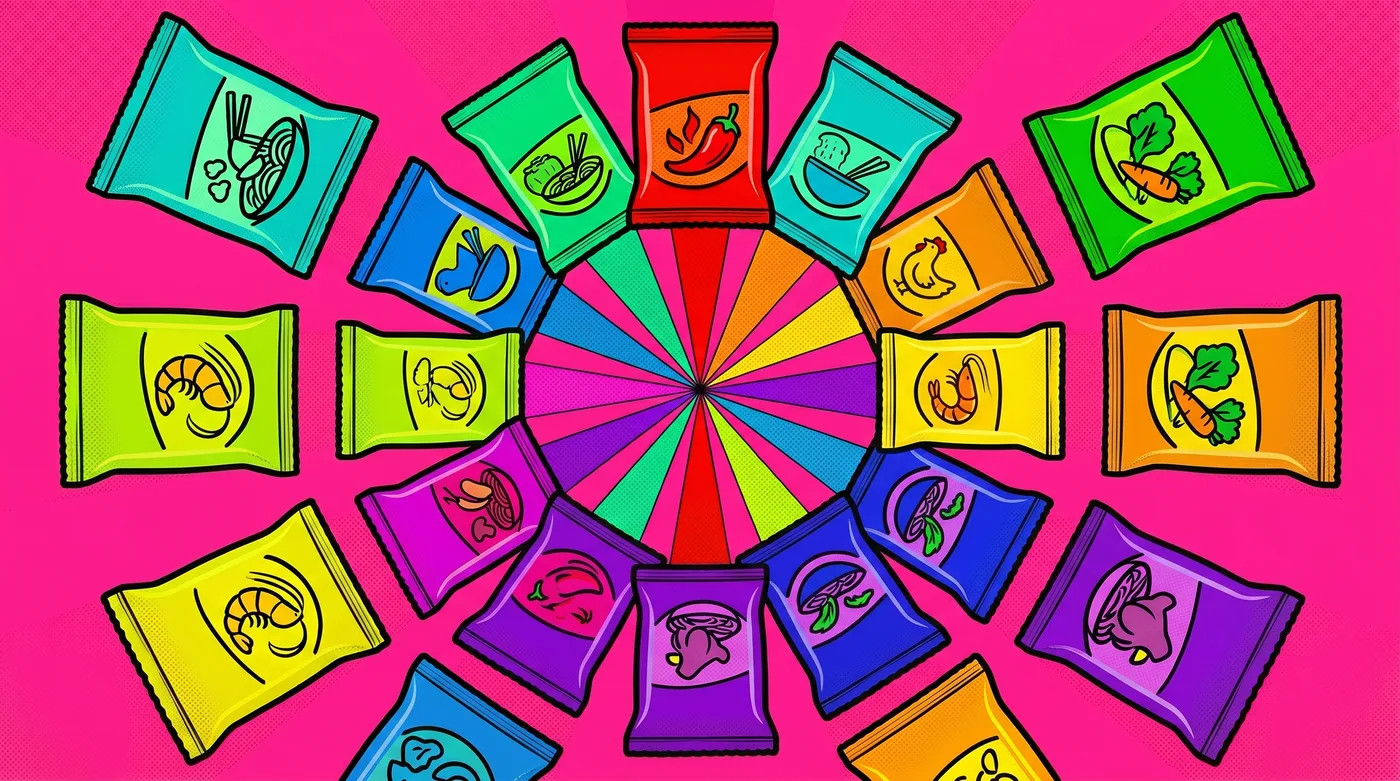
Plus Cup format versions of most flavors (smaller serving, designed for hot-water-only prep), Big Bowl larger cups, and the occasional regional-exclusive launch (Mala, Black Bean Ssamjang, etc.) that doesn't reach US distribution.
For the parent brand history, the company that makes it, and the cultural-virality timeline, see the Buldak brand page. This page covers the flavor lineup specifically — what each variant is, who it's for, and which to buy first.
The Original (2012) — the canonical fire chicken
The product that started everything. Launched April 16, 2012 at retail price ₩900 (about $0.75 USD then). The flavor profile: sweet-savory chicken base with concentrated gochugaru heat and a smoky finish. The noodles cook in 5 minutes; the sauce packet (~30g of concentrated chili paste) is mixed in after draining. 4,404 SHU, the published Samyang figure. Same value for every Original variant since 2012 — the chemistry hasn't changed in over a decade.
The red bag is the brand's defining product. Roughly 60% of Buldak revenue comes from Original, even as the Carbonara and 2x Spicy variants have grown faster in percentage terms. For a first Buldak purchase by someone who can handle spice, Original is the canonical choice.
The Cheese (2014) — the gateway
Buldak Cheese was the first variant after Original, launched July 2014 — two years into the product line, when Samyang realized that the Fire Noodle Challenge virality wasn't bringing in everyday eaters. The Cheese version mellows perceived heat dramatically (down to ~2,400 SHU effective) by adding a dehydrated cheddar-style cheese powder to the sauce mix. The result is a creamy-spicy hybrid that introduces casual eaters to the brand without the punishing intensity of Original.
For introducing a friend to Buldak who's never tried it, Cheese is the gentlest entry — even softer than Carbonara. The trade-off is that the Buldak character (smoky, chili-forward, Korean-distinct) is buried under the cheese; some longtime fans dismiss it as "not really Buldak." Both views are valid.
The Carbonara (2017) — the breakout
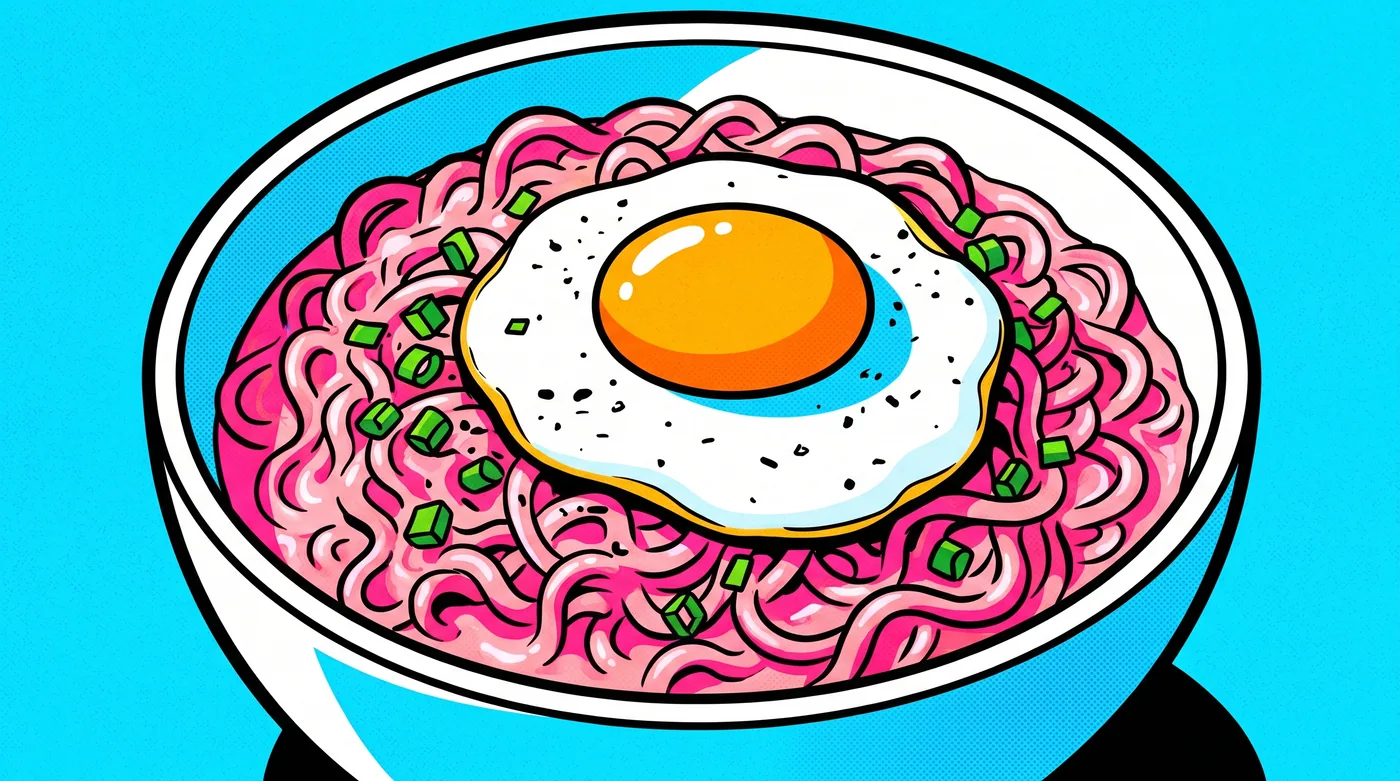
March 2017 launch. The single most consequential product Samyang has released after the Original. Carbonara takes the same Buldak noodle base, the same 4,404 SHU spice tier, and adds cream powder + cheese powder + cracked black pepper to create a rosé-pink creamy emulsion. The result reads more like a spicy pasta than instant ramen — and that hybrid identity is exactly what made it viral.
Carbonara's TikTok moment came in 2020-2022, peak K-food virality. Korean-American food creators (especially Joshua Weissman in late 2021 and a wave of cottage-cheese-Buldak-Carbonara creators in 2022) made the variant the most-bought Buldak SKU on Amazon US. Among US fans under 25, Carbonara is Buldak — many never try the Original.
A common preparation hack the bag doesn't print: add 2-3 tablespoons of milk to the drained noodles before stirring in the sauce. The dairy further buffers the heat and makes the emulsion glossier. Almost every Korean food blogger uses this version.
The 2x Spicy / Hek (2017) — the dare
Launched simultaneously with Carbonara in March 2017. The matte black bag, designated Hek (Korean for extra) or sometimes labeled 2x Spicy. Same Buldak noodle, double the chili oil. Published Scoville: 8,706. The result is genuinely hot — into upper jalapeño / lower serrano range on the pepper scale.
For most spice-tolerant adults, 2x Spicy is the practical upper limit. The Fire Noodle Challenge format that built Buldak's global identity in 2014-2018 was specifically built around 2x Spicy; the video content of someone visibly suffering through 2x Spicy is the canonical Buldak meme.
The 2x is widely distributed (Walmart, Costco, Target, every Asian grocery). For someone who's worked through Original and Carbonara and wants the next tier, 2x is the next step. Stop here unless you specifically want the rarer 3x.
The Jjajang (2018) — the savory crossover
Glossy black bag, often confused with the 2x Spicy at first glance. Buldak Jjajang is a savory-not-spicy variant — same noodle base, but the sauce packet replaces the chili paste with Korean chunjang (fermented black-bean paste). The result is a dark, savory, slightly sweet stir-fried noodle that's much closer to traditional jjajangmyeon than to fire-noodle Buldak.
The spice tier is dramatically lower (~2,800 SHU, mild). The product is positioned as a Buldak for people who don't want fire — a savory variant that keeps the Buldak brand identity but moves to a completely different flavor category. For US shoppers seeking Korean jjajangmyeon flavor in an instant format, Buldak Jjajang competes directly with Nongshim's Chapagetti.
The Curry (2018) — the Korean curry hybrid
Mustard-yellow bag. Buldak Curry combines the Buldak heat profile with Korean-style curry seasoning. Korean curry leans sweeter and milder than Japanese curry (which is itself milder than Indian curry), so the variant lands as a spicy curry stir-fried noodle with a complex savory base.
Spice tier is ~4,000 SHU — close to Original. The curry flavor is the dominant note, which makes this variant less obviously "Buldak" than the Original or 2x Spicy. For US shoppers, this is one of the more divisive variants — fans love the curry-chili combination, detractors find it muddled.
Habanero Lime (2020), Quattro Cheese (2021), Truffle (2022)
The premium-positioning variants. Each is a Samyang attempt to extend Buldak upward into the gourmet instant tier.
Habanero Lime (2020) uses habanero pepper extract instead of the standard gochugaru-based chili oil, plus a lime acidity component. The result is sharper, brighter, with a tropical-pepper profile. Spice tier ~5,500 SHU. Bright green bag. Limited US distribution.
Quattro Cheese (2021) extends the Cheese concept — four different cheese powders (cheddar, mozzarella, parmesan, gouda) instead of one. Slightly hotter than the Cheese (~3,200 SHU) and considerably more cheese-forward. Cream-colored bag.
Truffle (2022) is the premium-tier outlier — adds dried-truffle-powder seasoning and a small truffle-oil packet to a milder version of the Buldak base (~3,500 SHU). Charcoal-and-gold bag. The premium positioning ($3.99+ per single packet) limits mainstream uptake.
Stew (2018) and Ice (2022) — format experiments
Samyang has used Buldak's brand strength to push into adjacent formats.
Buldak Stew (2018) — soup format. Same chili tier as Original (4,404 SHU), but designed to be served as a true Korean-style soup-noodle (jjigae) with broth, not as drained stir-fried noodle. Maroon bag. Korean-domestic-only for years, occasionally appearing in US specialty markets.
Buldak Ice (2022) — cold preparation. Designed to be cooked, then cooled with ice, then sauced. Pale blue bag. Korea-domestic-focused; the format hasn't translated well to US grocery distribution.
Both are interesting experiments but neither has approached the mainstream success of the core variants.
Cup format vs Packet format
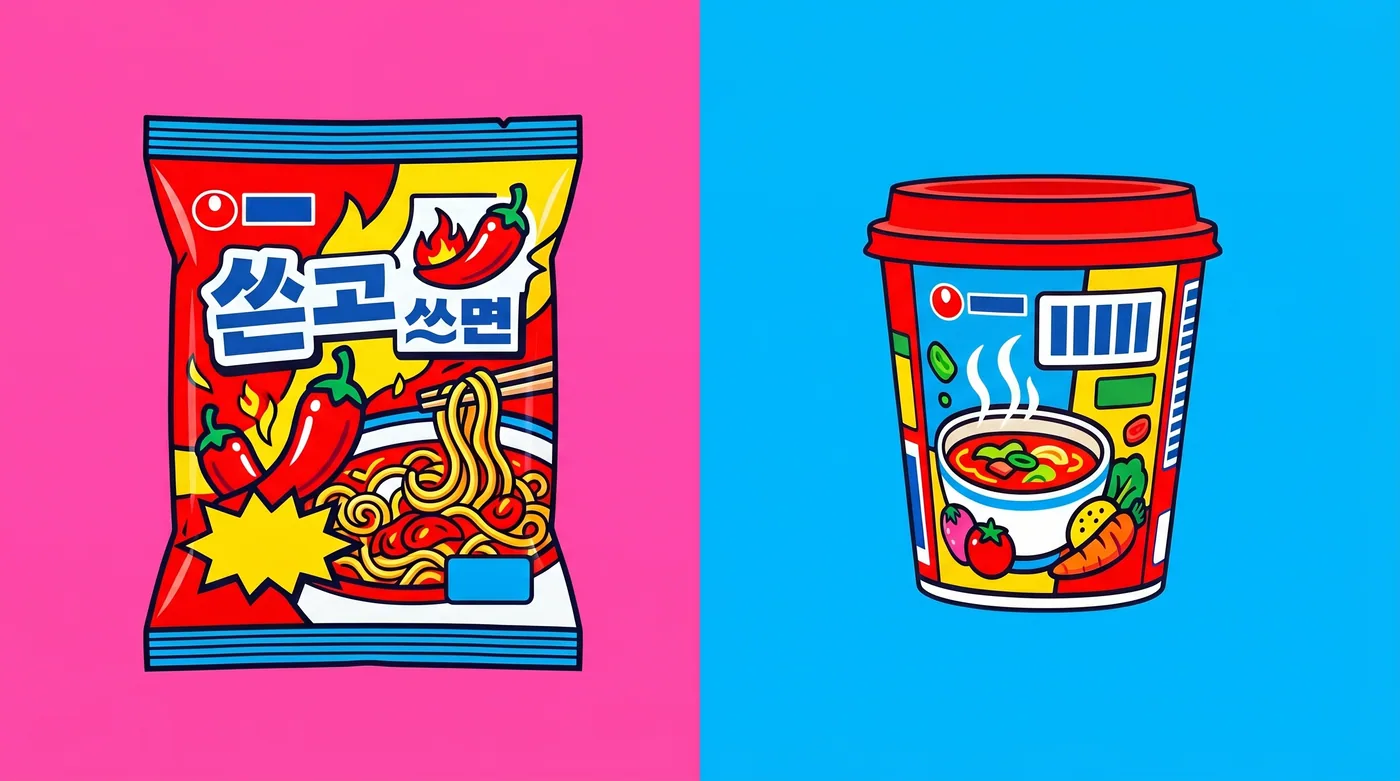
Most Buldak flavors are sold in both packet (the dry single-serve bag, requires a pot) and cup (a smaller styrofoam cup, hot water only). The two formats are not equivalent — the cup version typically ships:
- ~30% less noodle per serving
- A simplified seasoning packet (often missing the separate flavored-oil sachet)
- Pre-fried noodles processed for hot-water-only reconstitution
For most Buldak flavors, the packet version is the canonical product. The cup is a convenience version. The flavor character is preserved but at lower intensity.
For office and dorm contexts where pot access isn't available, the cups work. For dedicated Buldak eating where the full intensity matters, always buy packets.
Which Buldak should you actually buy first?
| If you... | Buy this | Why |
|---|---|---|
| Have never tried Buldak | Carbonara (pink bag) | Same Scoville as Original but cream-buffered for first-time tolerance |
| Have eaten extra-spicy food before | Original (red bag) | The canonical flagship — the brand's defining product |
| Want maximum heat | 2x Spicy (matte black bag) | Doubles published Scoville; widely available |
| Want something not spicy | Jjajang (glossy black bag) | Same brand, completely different category — savory black-bean |
| Want to try every variant | 5-flavor Variety Pack | Original, Carbonara, Cheese, Curry, Jjajang in one box |
| Are introducing a child or spice-sensitive friend | Cheese (yellow bag) | Lowest perceived heat in the lineup |
Stop in this sequence: Carbonara → Original → 2x Spicy → 3x Spicy (if you find it). Don't skip directly to 3x — the gap between 2x and 3x is far less dramatic than from Original to 2x, and tolerance built across the easier tiers transfers.
FAQ
How many Buldak flavors are there? Roughly fourteen active variants as of 2026, plus five-to-seven limited releases that appear seasonally.
Which Buldak should I buy first? Carbonara (pink bag) for most first-timers. Original red bag for spice-experienced eaters. Skip 2x Spicy on a first-time purchase.
What's the pink Buldak? Carbonara. Same 4,404 SHU as Original but cream-buffered. The most-purchased Buldak variant on Amazon US.
What's the black Buldak? Two products: 2x Spicy / Hek (matte black, spicier) and Jjajang (glossy black, savory not spicy). Read the front-label text carefully.
What's the difference between Buldak Original and Stew? Format. Original is stir-fried (drained, sauced); Stew is soup (broth, served wet). Same chili profile.
What's the rarest Buldak flavor? 3x Spicy among the active lineup (intermittent limited releases). Truffle among the seasonal releases.
Read Next
- Buldak — the brand history and Samyang origin
- The Spiciest Noodles in the World, Ranked
- Shin Ramyun vs Buldak — side-by-side comparison
- Samyang Foods — the parent company
- Best Korean Instant Ramyeon