
Ottogi isn't a brand most non-Koreans can name. Inside Korea, it's the company most Koreans trust most — nicknamed 갓뚜기 (Gattugi, God Ottogi) for its ethical employment record, beloved for the 3-Minute Curry that has sat in Korean pantries for forty years, and a quietly successful #3 in Korean instant noodles with Jin Ramen. Here's the company that built its reputation by being unflashy.
What is Ottogi?
Ottogi Corporation (오뚜기, oh-ttoo-gee) is a South Korean food manufacturer founded in May 1969 by Ham Tae-ho (1930–2016). The company is listed on the KOSPI (ticker 007310), headquartered in Seoul, and produces a wide portfolio of ready-meal pouches, instant noodles, sauces, snacks, and prepared foods.
In the Korean instant-noodle category, Ottogi is the persistent #3 — behind Nongshim (~55% market share) and Samyang (~25%), Ottogi sits at roughly 15-20 percent. But in the broader Korean home-meal category, Ottogi is dominant: its 3-Minute Curry retort pouches have been the country's leading ready-meal curry brand since 1981, with no serious challenger.
The name 오뚜기 means roly-poly doll — the bottom-weighted Korean tumbler toy that always returns to upright when pushed. The mascot appears on most Ottogi packaging, and the symbolism (resilience, return to standing) is core to the company's identity.
The 1969 founding and Ham Tae-ho's philosophy
Ham Tae-ho founded the company in 1969 with an initial product line of ketchup, mayonnaise, and tomato sauce — categories where Korea had no domestic alternative to imported brands at the time. The company's first commercial breakthrough came in 1971 with Ottogi Tomato Ketchup, which displaced imported brands and became the standard Korean ketchup within five years.
The 1981 launch of 3분 카레 (3-Minute Curry) — Korea's first shelf-stable retort-pouch ready-meal — was the second pivotal product. The retort-pouch format was a category Japan had developed in the late 1960s; Ottogi adapted the technology for Korean palates with a milder, sweeter curry profile than the Japanese original. Within three years, 3-Minute Curry was outselling Korean home-cooked curry by volume across major cities.
Jin Ramen launched in 1988, a slow-build product that took roughly a decade to find its place. Ottogi's instant-noodle entry was deliberately positioned as milder than Shin Ramyun and Samyang Ramen — designed for Korean families with children rather than the spicy-intensity-seeking adult market that Nongshim and Samyang were chasing. The strategy worked: by 2005, Jin Ramen had become the most-purchased Korean instant noodle in households with young children.
Ham Tae-ho ran the company until his death in 2016. His grandson, Ham Young-joon, is now chairman. The family ownership has remained continuous and tight; Ottogi's float on KOSPI is one of the smallest of any major Korean food company, and the stock is famously hard to buy.
Why Koreans call Ottogi God Ottogi

Korean retail investors and food shoppers started calling Ottogi 갓뚜기 (Gattugi) in the early 2010s. The portmanteau combines the English God with Ottogi's name. The compliment is specifically about corporate ethics — not religion, not product quality.
Three documented practices drove the nickname:
- Roughly 95 percent of Ottogi's workforce is permanent (non-contractor) employees — extraordinarily high in Korean food manufacturing, where contractor labor commonly exceeds 50 percent of headcount. Permanent employees have benefits, job security, and tenure rights that contractors don't.
- Ottogi has not conducted mass layoffs during major Korean economic downturns (1997 Asian Financial Crisis, 2008 Global Financial Crisis, 2020 COVID). Many competitors used the crises as cover for staff reductions; Ottogi did not.
- Founder Ham Tae-ho's modest estate. When Ham died in 2016, his personal estate was strikingly smaller than peer Korean food-company founders, in part because he had used personal funds to subsidize worker pay during the 1997 crisis. He also reportedly refused several hostile-acquisition payouts that would have enriched the family but harmed worker job security.
The God Ottogi designation has stuck. As of 2024, Ottogi consistently ranks at the top of Korean Consumer Trust Index surveys for the food category, ahead of both Nongshim and Samyang.
The product family
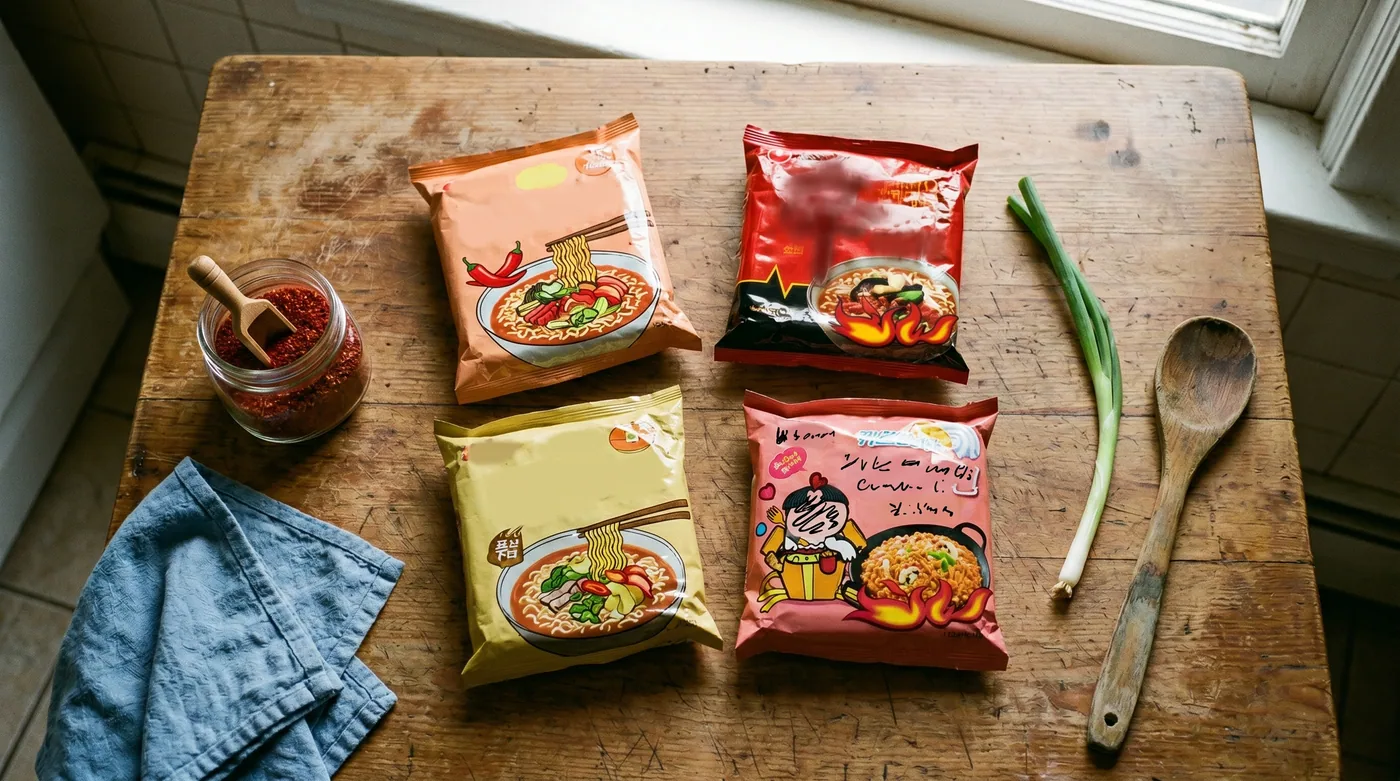
Ottogi's portfolio is broader than the instant-noodle category most Western consumers know. Major product lines:
Instant noodles:
- Jin Ramen Mild (1988) — the milder flagship
- Jin Ramen Hot (매운) — the spicier sibling, closer to Shin Ramyun's heat
- Yeolla Yeolla — premium extra-spicy line (Ottogi's Buldak competitor, launched ~2017)
- Real Cheese Ramen — cheese-broth variant
- Ottogi Jjajang — black-bean noodle alternative to Chapagetti
- Ottogi Bibim Myun — cold spicy mixed noodle, summer staple
- Jin Cup Noodle — cup format
Ready meals and retort pouches:
- 3-Minute Curry (1981) — beef, chicken, vegetable, hot variants
- 3-Minute Yukgaejang — spicy beef soup pouch
- 3-Minute Galbitang — beef-rib soup pouch
- 3-Minute Bulgogi — Korean BBQ beef pouch
- 3-Minute Spaghetti — pasta-with-sauce pouch
- 3-Minute Donkkaseu Sauce — Japanese-style pork cutlet sauce
Sauces and pantry staples:
- Ottogi Tomato Ketchup (1971) — Korea's dominant ketchup brand
- Ottogi Mayonnaise
- Ottogi Sesame Oil
- Ottogi Soup Stock
Snacks and breakfast:
- Ottogi Cornflakes — Korea's first domestic breakfast cereal
- Ottogi Bbasak (crispy seaweed)
For US shoppers, the most important products to know are Jin Ramen Mild (the gateway Ottogi instant), 3-Minute Curry (the most-imported Ottogi product), and Yeolla Yeolla (the spicy-line that competes with Buldak).
Jin Ramen — the quiet workhorse
Jin Ramen sits in the same instant-noodle category as Shin Ramyun and Samyang Ramen, but it's positioned distinctly: milder, more rounded, more family-friendly. The broth is a beef-and-anchovy base with red pepper accent (not the gochugaru-forward profile of Shin Ramyun); the noodle is slightly thinner; and the seasoning packet is calibrated to a lower spice tier — roughly 1,000-1,500 SHU for Jin Ramen Mild, versus Shin Ramyun's ~2,700 SHU and Buldak's 4,404+ SHU.
This positioning was a strategic choice. By 1988, when Jin Ramen launched, Shin Ramyun and Samyang Ramen had already locked the spicy-adult market. Ottogi chose to differentiate by going softer — and won the Korean family-with-kids segment as a result. Jin Ramen is the noodle most Korean elementary schoolers grew up eating; it's the brand parents trust for their children before introducing them to the spicier mainstream.
In the US market, Jin Ramen Mild is the gentlest introduction to Korean instant noodles. For someone whose spice tolerance can't handle Shin Ramyun, this is the right entry point.
3-Minute Curry — Korea's microwaved staple since 1981
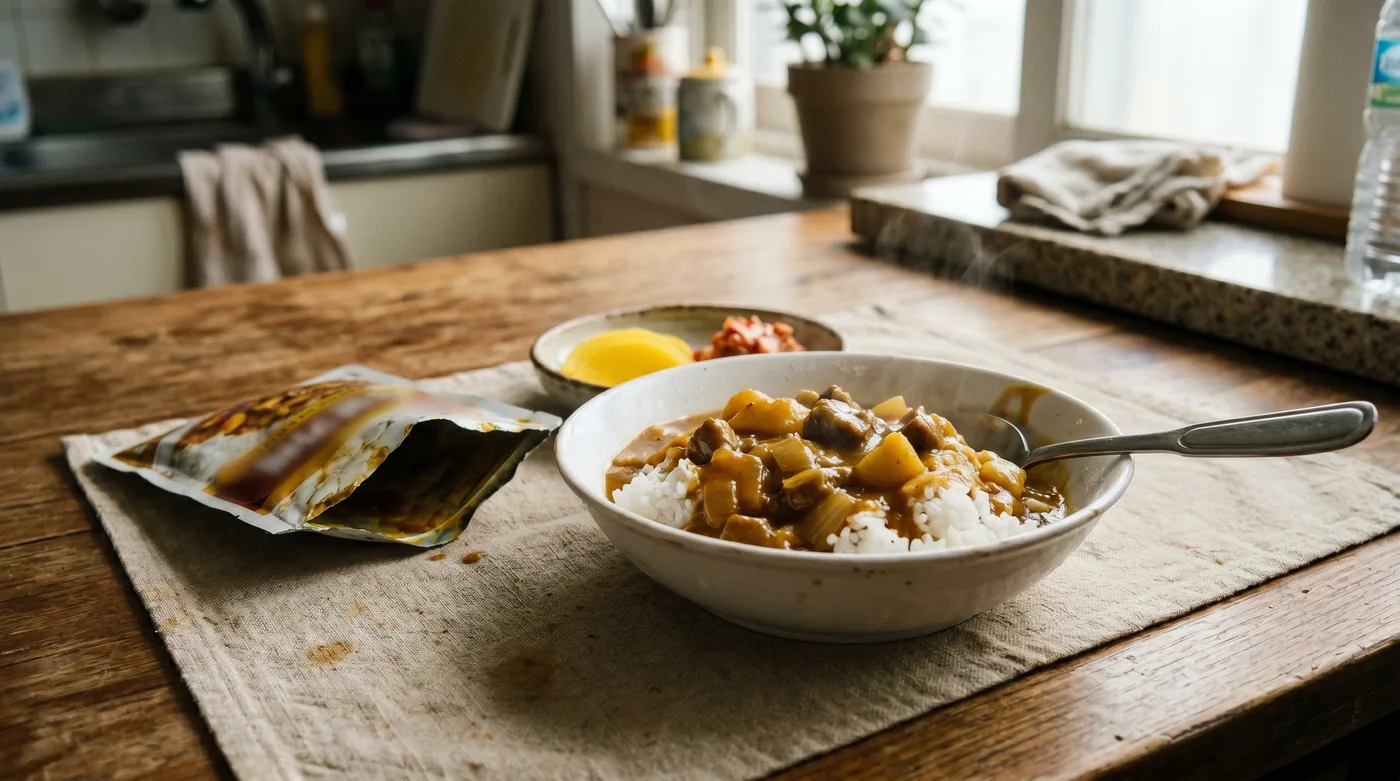
The shelf-stable retort-pouch curry deserves its own discussion because it is the single product most Korean households have in their pantry at any given moment. 3분 카레 (3-Minute Curry) launched in 1981 as Korea's first retort-pouch ready meal. The product format — a heat-sealed sterile pouch of cooked curry that requires no refrigeration and reheats in 3 minutes — predated the global ready-meal trend by more than a decade.
The curry profile is Japanese-derived but Korean-adapted: milder than Indian curry, slightly sweeter than the Japanese-restaurant version, with a more vegetable-forward base. Four standard variants ship in the US: Beef (the canonical), Chicken, Vegetable, and Hot. The Hot variant is the only one with a noticeable spice tier, and even that is mild by Korean standards.
Prep is the selling point: rip open the pouch, drop into boiling water for 3 minutes, or cut open and microwave 90 seconds. Pour over hot rice. The dish is shelf-stable for 2+ years unopened. Most Korean households restock these in bulk; college students treat them as the dinner default; office workers heat them in shared microwaves at lunch.
3-Minute Curry has had no serious Korean competitor in 43 years. The product is one of the cleanest examples of a category-defining first mover that no one has been able to displace.
Where Ottogi sits in the Korean instant-noodle big three
| Nongshim | Samyang | Ottogi | |
|---|---|---|---|
| Founded | 1965 | 1961 | 1969 |
| Flagship instant | Shin Ramyun (1986) | Samyang Ramen (1963) / Buldak (2012) | Jin Ramen (1988) |
| Domestic market share | ~55% | ~25% | ~15-20% |
| Global export volume | High (Shin Ramyun, broad) | Highest (Buldak, viral) | Low (Korean-focused) |
| Positioning | Everyday, ubiquitous | Viral, event-driven | Mild, family, ethical |
| Cultural identity | The default | The fire | The trusted family brand |
The three companies don't compete head-on in every product category. Nongshim and Samyang fight for the spicy/intense space; Ottogi mostly cedes that and dominates the milder family category plus the broader prepared-meals market (where Nongshim and Samyang have minor positions).
For an American shopper wanting to know all three big Korean food brands, Ottogi is the missing puzzle piece. The brand most Koreans actually trust most.
Where to buy Ottogi in the US
Ottogi's US distribution is narrower than Nongshim's and broader than most other Korean food brands.
- H Mart — full Ottogi lineup including 3-Minute Curry pouches, Jin Ramen, Yeolla Yeolla, and Korean-domestic-exclusive variants.
- 99 Ranch Market — Jin Ramen, Yeolla Yeolla, 3-Minute Curry reliably. Other variants by location.
- Amazon US — every major Ottogi variant in 5-pack or 10-pack format.
- Walmart, Target — Jin Ramen Mild at some locations; not consistently stocked. Ottogi has not invested in mainstream US distribution at the level Nongshim has.
- Costco — Jin Ramen variety packs occasionally as a seasonal SKU.
- Whole Foods — usually no Ottogi presence.
For halal-certified Ottogi, the Indonesia/Malaysia/Gulf-market product line carries KMF certification; US stocks generally do not. Check the side panel.
FAQ
What does Ottogi mean? Roly-poly doll — the bottom-weighted Korean tumbler toy that always returns upright when pushed. The doll appears on most Ottogi packaging and symbolizes resilience.
Why is Ottogi called God Ottogi? Korean shoppers nicknamed the company 갓뚜기 (Gattugi) for its unusually ethical employment record — ~95% permanent employees (rare in Korean food manufacturing), no mass layoffs during recessions, and a founder who used personal funds to support workers during the 1997 Asian Financial Crisis.
How is Ottogi different from Nongshim and Samyang? Position and personality. Nongshim is the everyday default. Samyang is the viral export brand. Ottogi is the trusted family-pantry brand — mild noodles, ready-meal pouches, and a corporate reputation as Korea's most ethical food employer.
What is Ottogi's 3-Minute Curry? Korea's first retort-pouch ready meal, launched 1981. Shelf-stable curry in heat-sealed pouches, reheats in 3 minutes. Most Korean households keep several pouches in the pantry. No serious competitor in 43 years.
Is Jin Ramen available in mainstream US grocery? Some — H Mart, 99 Ranch, Amazon stock the full lineup; Walmart and Target carry Jin Ramen Mild at some locations but not consistently. Ottogi has not pursued mainstream US distribution at Nongshim's level.
Is Ottogi halal-certified? Some export lines are KMF-certified for Muslim-majority markets. US-stocked Ottogi products typically are not — check side panel.