Korean Ramyeon vs Japanese Ramen (2026): Which Wins Your Bowl
Compare Korean ramyeon and Japanese ramen by broth base, noodle bite, and shop vs home format. Decide which bowl fits your kitchen or your next counter trip.

Korean ramyeon and Japanese ramen aren't the same dish. They share a name (the Korean is a transliteration of the Japanese, which is a transliteration of the Chinese lamian), and they share a base noodle (wheat flour + alkaline salt), but the two food cultures use that shared starting point to build completely different traditions. Here's the actual difference.
The headline difference
Japanese ramen is restaurant-first. Korean ramyeon is home-first. That single distinction explains nearly every other divergence between the two.
Japanese ramen is built around the ramen shop — a counter restaurant where a specialist chef has spent hours preparing a single complex broth that the diner eats one bowl of, on the spot. The product format that matters is the shop bowl. Instant Japanese ramen exists (Nissin, Sapporo Ichiban, Maruchan) but it sits in a separate category as a convenience product, not the cultural center.
Korean ramyeon is built around the home kitchen — a quick instant noodle prepared in a pot, eaten alone or with family in 10 minutes total. The product format that matters is the packet. Korean restaurants serve ramyeon, but it's typically the same instant product the diner could buy at the grocery, prepared with a few additions. The cultural center is in the home.
This format inversion drives everything else.
The noodle itself
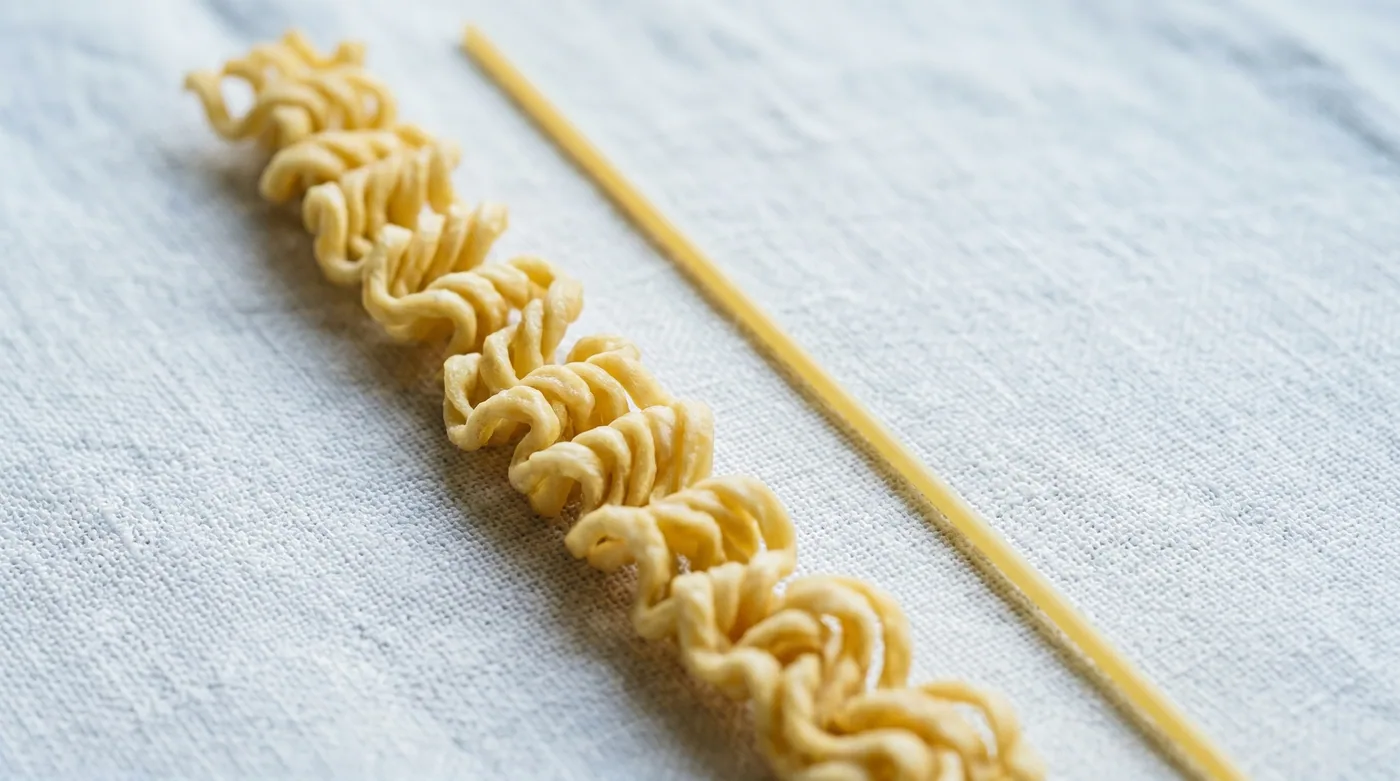
Both traditions use wheat-flour noodles raised with an alkaline salt called kansui in Japanese or jian shui in Chinese. The alkaline shift in the dough changes how wheat proteins bond — it produces the springy yellow noodle character that defines both ramen and ramyeon. So the base ingredient is shared.
The differences come from format:
| Aspect | Japanese ramen | Korean ramyeon |
|---|---|---|
| Standard format | Fresh refrigerated (shops) or premium dry (retail) | Pre-fried instant |
| Cook time | 60-120 seconds (fresh) | 4-5 minutes (instant) |
| Texture | Firmer, more al dente | Softer, distinctively curly |
| Color | Pale yellow (kansui-yellow) | Pale yellow to off-white |
| Shelf life | 7-10 days (fresh) | 8-12 months (instant) |
| Typical thickness | Variable by region (Hakata thin, Sapporo thick) | Standardized medium |
The pre-frying process is the single biggest technical difference. Korean ramyeon noodles are deep-fried briefly during manufacturing to drive out moisture, then dried — this is what makes them shelf-stable for nearly a year. The trade-off is texture: pre-fried noodles never quite recover the springy bite of fresh noodles, but they cook in any kitchen in 4 minutes.
Japanese ramen's tradition emphasizes texture as the primary noodle quality. Korean ramyeon's tradition emphasizes convenience.
The broth philosophy
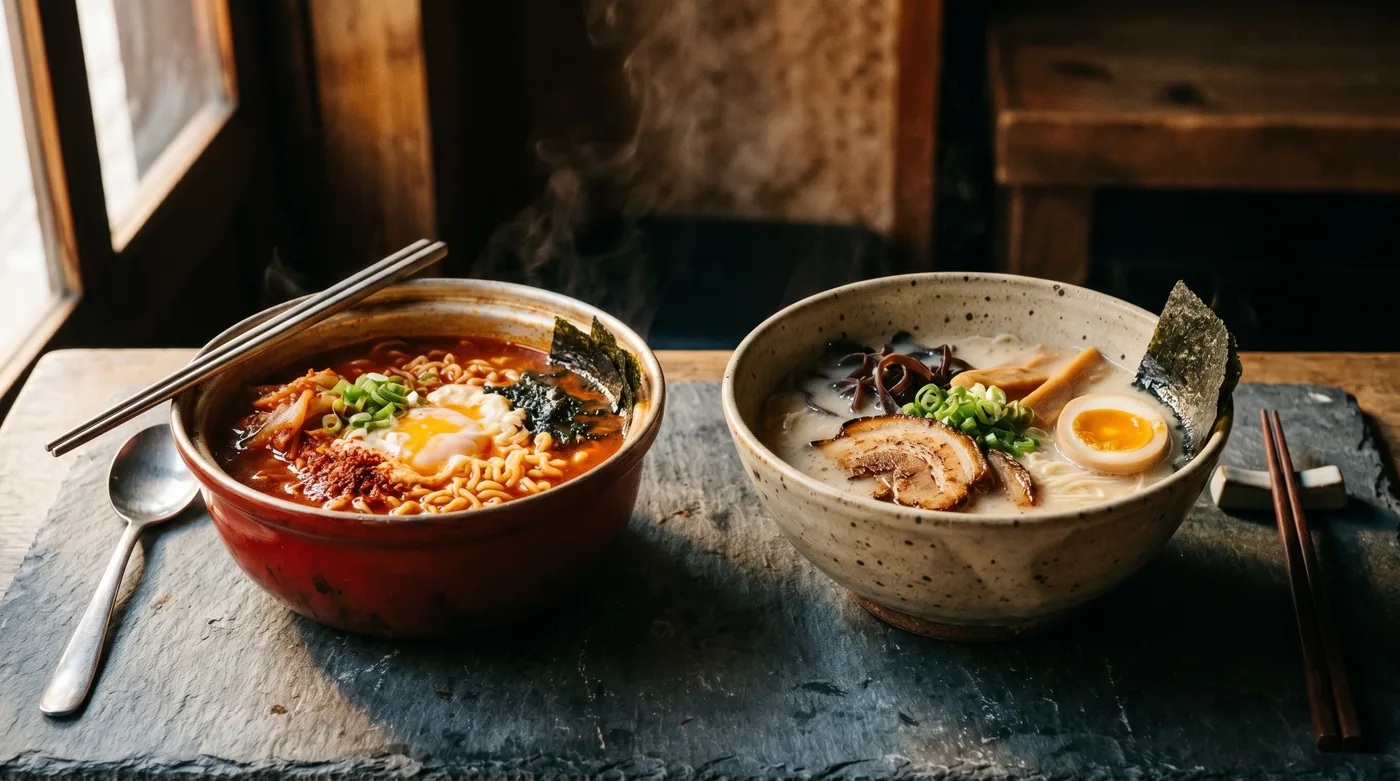
If the noodles diverge in format, the broths diverge in flavor architecture.
Japanese ramen broth is built around tare — a concentrated sauce base that defines the bowl's identity. The four canonical tare styles are:
- Tonkotsu (pork-bone) — the cloudy collagen-rich Hakata style
- Shoyu (soy sauce) — the Tokyo classic, lighter and brighter
- Miso (fermented soybean paste) — the Sapporo style, hearty and dense
- Shio (salt) — the lightest, often with seafood notes
The broth is a base stock (pork or chicken bones, dried fish, kombu) plus the appropriate tare, finished with aromatics and oil. The chef's signature is in the tare. The cooking time is long — quality tonkotsu requires 12+ hour bone simmer.
Korean ramyeon broth is built around gochugaru (red pepper flakes) and gochujang (red pepper paste). The base is typically beef-and-anchovy stock; the seasoning is red-pepper-forward with garlic, ginger, and soy components. The cultural identity is spicy hearty soup. Cooking time is 5 minutes — the seasoning packet is reconstituted in boiling water, not slow-built from raw ingredients.
Japanese ramen broth aims for depth and refinement. Korean ramyeon broth aims for immediacy and heat. Neither approach is better; they're built for different occasions.
The cultural format — instant-first vs restaurant-first
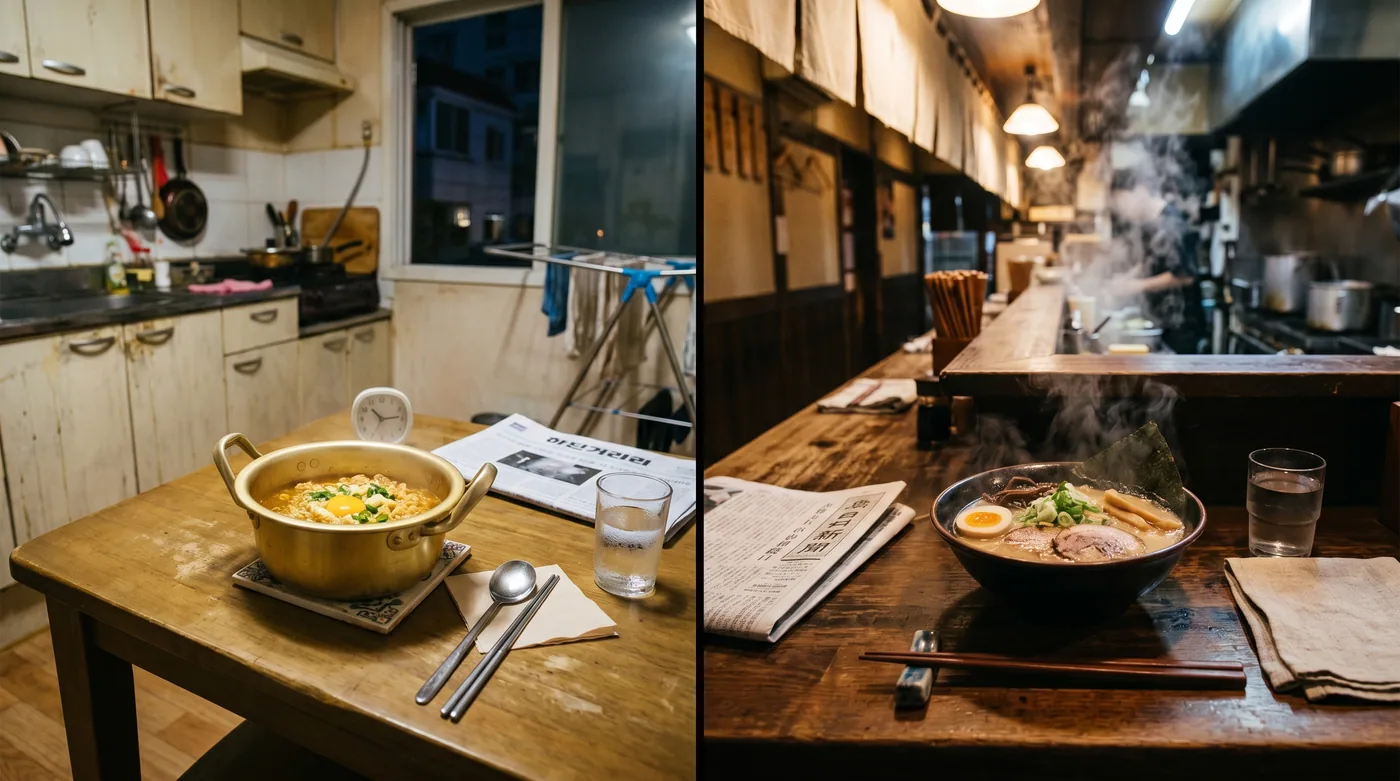
The clearest way to understand the divergence is through history.
In Japan, ramen developed as a restaurant dish from 1910 onward — Chinese immigrants in Yokohama and Tokyo opening Chuka soba shops that served wheat noodles in a Chinese-influenced broth. By the 1950s, regional Japanese ramen identities had crystallized (Sapporo miso, Hakata tonkotsu, Tokyo shoyu). When Nissin's Momofuku Ando invented instant ramen in 1958, he was creating a convenience version of an already-existing restaurant dish. The instant format was secondary to the cultural anchor of the ramen shop.
In Korea, the noodle tradition followed almost the opposite arc. Pre-1963 Korea had no significant instant noodle category. When Samyang's Jeon Joong-yoon visited Nissin in 1962 and licensed the manufacturing technology, he was introducing an entirely new product format to Korea. Samyang Ramen launched September 1963 as Korea's first instant noodle — and from day one, ramyeon in Korean meant the instant product, not a restaurant dish. Korean ramen restaurants do exist now (especially in Seoul and Busan, many serving Japanese-style tonkotsu), but the cultural identity of ramyeon remains the home-prepared instant bowl.
This is why the two words diverge in meaning despite the shared root: in Japan, the instant product is a version of the restaurant dish. In Korea, the instant product is the dish.
Side-by-side comparison
| Japanese ramen | Korean ramyeon | |
|---|---|---|
| Origin | Chinese immigrants in Yokohama / Tokyo, 1910 | Samyang Foods, Seoul, 1963 |
| Cultural center | Restaurant counter (~50,000 shops in Japan) | Home kitchen + instant grocery |
| Standard format | Fresh restaurant or premium dry | Pre-fried instant |
| Defining seasoning | Tare (4 canonical styles) | Gochugaru / gochujang |
| Typical spice tier | Mild (regional spicy variants exist) | Moderate to hot (gochugaru baseline) |
| Standard prep time | 12+ hours (broth) + 90 seconds (noodle) | 4-5 minutes total |
| Cultural ritual | Eaten at the counter, alone, fast | Eaten at home, often shared, casual |
| Iconic restaurant brands | Ichiran, Ippudo, Jinya | Most Korean ramyeon brands are grocery brands, not restaurants |
| Iconic retail brands | Maruchan (US), Nissin (global), Sapporo Ichiban (Japan) | Nongshim (Shin Ramyun), Samyang (Buldak), Ottogi (Jin) |
| Global export volume | Lower per capita; restaurant tradition exports slowly | Higher per capita; instant format exports easily |
| Most-eaten product worldwide | Nissin Cup Noodles (instant) | Shin Ramyun (instant) |
Which to start with, if you're new to either
If you've never eaten either tradition, the right entry point depends on the format you have access to.
For an introduction to Japanese ramen, eat it at a restaurant first. The instant version is a convenience product — fine for context, but not the cultural anchor. Find a Japanese ramen shop in your metro (Ichiran and Ippudo both have US locations; smaller independent shops are everywhere from LA to Boston). Order a tonkotsu first; that's the broth style most likely to convert a first-timer. Then try shoyu and miso. The restaurant experience is the canonical version.
For an introduction to Korean ramyeon, buy a packet at H Mart or Walmart and prepare it at home. Shin Ramyun Original is the canonical starting point — it's been Korea's best-selling instant noodle since 1991, and it's stocked in every major US grocery chain. Cook it as the packet says (4 minutes 30 seconds, full water), add a soft-cooked egg, top with chopped scallion if you have it. That's the cultural experience.
Trying instant Japanese ramen first or restaurant Korean ramen first would be like learning about Italian food via Olive Garden or about American barbecue via a McDonald's McRib — technically accurate, but missing the cultural center entirely.
Where the two traditions overlap
Some product categories blur the line:
- Premium instant ramen kits (Ichiran Take-Home Tonkotsu, Ippudo retail kit) take Japanese restaurant ramen and reformat it as a home product. The result is closer to Japanese ramen than to Korean ramyeon, but the format borrows from Korean culture.
- Premium Korean ramyeon variants (Shin Black, Ottogi Yeolla Yeolla, Samyang Premium lines) try to elevate instant Korean ramyeon toward restaurant-tier ingredients. Some succeed; none reach actual restaurant-Japanese-ramen quality, but they narrow the gap.
- Crossover restaurants — Tokyo and Osaka have a small number of Korean ramyeon-themed restaurants, and Seoul has a meaningful tonkotsu scene. Neither has gone mainstream in the other country.
The trend toward convergence is real but slow. The fundamental format difference (restaurant-first vs home-first) shapes consumer expectations on each side too deeply to dissolve quickly.
The brands that exemplify each tradition
Japanese ramen is best represented by:
- Sun Noodle (US-based fresh ramen supplier — what most US ramen shops use)
- Ichiran (the Fukuoka Hakata-style tonkotsu chain)
- Ippudo (the Tokyo tonkotsu chain)
- Nissin (instant ramen inventor, global mass-market)
- Maruchan (the cheap American instant tier)
Korean ramyeon is best represented by:
- Nongshim Shin Ramyun (Korea's #1 since 1991 — see /brands/shin-ramyun)
- Samyang Buldak (the viral export brand — see /brands/buldak)
- Nongshim Chapagetti / Neoguri (the rest of Nongshim's anchor lineup — see /brands/nongshim)
- Samyang Ramen Original (the 1963 OG — see /brands/samyang)
- Ottogi Jin Ramen (the family-everyday Korean choice — see /brands/ottogi)
For a deeper dive on the Korean side, the dedicated brand pages cover each company in detail. For the Japanese side, the ramen type page and best ramen buying guide are the equivalent resources.
FAQ
Is Korean ramyeon the same as Japanese ramen? No. Different cultural traditions — Japanese is restaurant-centered with tare-built broths; Korean is home-centered with gochugaru-forward instant broths.
What's the difference between Korean and Japanese noodles in general? Japanese has specialized categories (ramen, udon, soba, somen). Korean clusters around fewer (ramyeon, jjajangmyeon, naengmyeon, kalguksu). Different specialization patterns.
Is Japanese ramen spicier than Korean ramyeon? Almost always no. Korean ramyeon is the spicier tradition. Japanese ramen broths typically rely on fat, umami, and salt rather than chili.
Which is older? Japanese ramen has a 50-year head start on the dish (1910 first shop) and 5 years on the instant format (1958 vs 1963 Korean).
Can I use Korean ramyeon noodles in Japanese ramen broth? Technically yes, but the pre-fried wavy texture is distinctly Korean. Result is adjacent to authentic Japanese ramen, not the same.
What about Korean ramyeon in Japan or Japanese ramen in Korea? Both exist as imported novelties; neither has displaced the local tradition.
Read Next
- Korean Ramyeon — Type Guide
- Japanese Ramen — Type Guide
- Shin Ramyun vs Buldak — same-cuisine comparison
- Best Korean Instant Ramyeon
- Best Ramen Noodles & Kits